

Taking content from X without attribution carries risk as well as reward
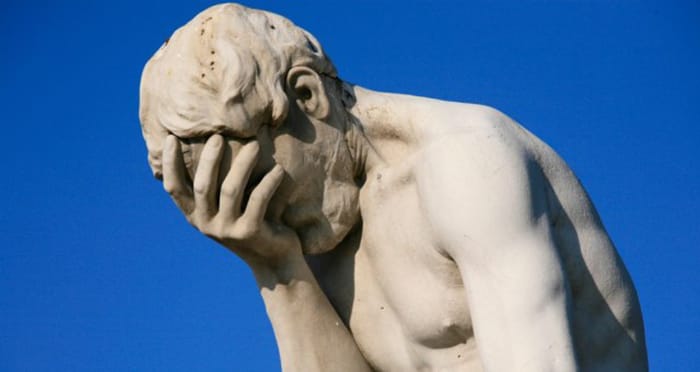
When it comes to media law, few names are more recognisable than veteran solicitor Mark Stephens CBE.
With a client list that over his long career has included Mike Tyson, Julian Assange and Princess Diana’s former lover James Hewitt, he’s long been a go-to for high profile celeb matters and often pops up in the press being quoted on one thing or another.
But even for such a legal legend, the changing media landscape presents a challenge. How to navigate the shift away from newspapers towards social media?
Stephens has busied himself for some time now with a multi-pronged strategy that sees him act essentially as a micro-aggregator for content on Elon Musk’s X, flagging general interest memes to an audience that he has built steadily since the days when the site was known as Twitter. He then typically posts some of this content on his LinkedIn, supplementing his own original output, while often taking a somewhat relaxed attitude to attribution.
The approach has proved effective, helping Stephens to attract over 33,000 LinkedIn followers. But last week it ran into trouble.
Reacting to news of Harry and Meghan’s return to the UK, Stephens posted on LinkedIn: “BREAKING‼️Cambridge University announce replacement for Jason Arday”, alongside an accompanying photo of Meghan Markle.
The post has since been deleted, but not before eagle-eyed RollOnFriday spotted it and grabbed a screenshot (re-produced below).
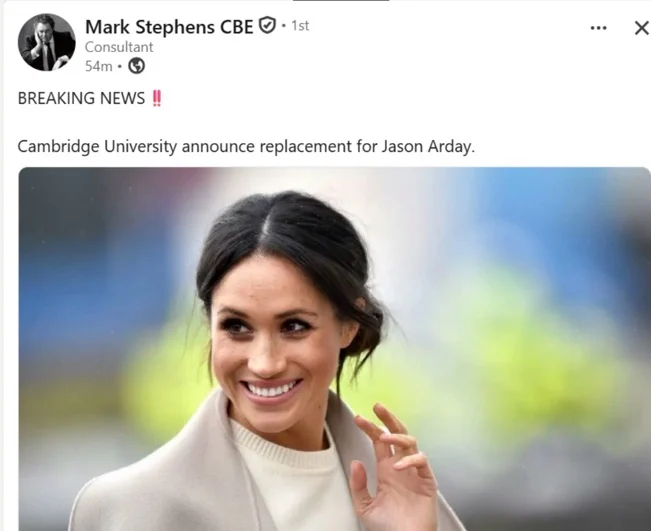
An almost identical post, by right wing influencer Suffragent, remains live on X.
BREAKING‼️Cambridge University announce replacement for Jason Arday. pic.twitter.com/4ObsBs4HXM
— Suffragent (@Suffragent_) August 20, 2026
To the casual observer, Stephens’ post may have seemed to mark something of an ideological departure from his previous LinkedIn musings about Jason Arday’s tragic death, where he stated:
“Editors of UK media are being compelled to reflect on the consequences of editorial decisions and ethics associated with their coverage of Professor Jason Arday. The problem for the media is that many were specifically warned that Prof Arday was vulnerable: (including) suicidal and didn’t stop… (and) if anything escalated reporting. Once Prof Arday had resigned, what was the public interest in continuing to pursue him? How much should foreseeable consequences have been taken into account in either the decision to publish or how and what to publish?”
Stephens says the “BREAKING‼️Cambridge University announce replacement for Jason Arday” post was misinterpreted, and he deleted it because of this, and that in sharing it he was trying to make a subtle point on race that many missed. He issued a long statement about this to RollOnFriday (which you can read in full here), but we have highlighted the key paragraph here:
“The target of the post was the racialised pattern of coverage and commentary, not the individuals concerned. Indeed, the comparison only works because both Professor Arday and Meghan Markle have, in different ways, been subjected to a level of attention that would not have been directed at a similarly situated white academic, public figure or celebrity. The post highlighted that double standard, it certainly did not seek to reinforce it.”
Regarding his wider social media strategy, Stephens issued this five-page statement to Legal Cheek. We have used ChatGPT to condense it into a summmary:
In a lengthy statement, Mark Stephens argues that the sharing and recirculation of ideas, observations and humour is an inherent part of public discourse and should not be confused with copyright infringement. He draws a distinction between attribution, which he describes as a matter of fairness, and ownership, which is governed by law, stressing that copyright protects original expression rather than ideas or information themselves. Stephens also notes that establishing the original source of online material can be difficult as content is repeatedly reposted, adapted and stripped of attribution, while accepting that passing off another person’s substantial original work as one’s own crosses a different line. Addressing his post about Professor Jason Arday specifically, he says it was intended to satirise what he regarded as the racialised treatment and double standards directed at Arday and Meghan Markle, rather than to criticise Arday himself, and that he deleted it after realising some readers had interpreted it differently.
Me when I accidentally repost a sketchy instagram post when scrolling reels
Mark Stephenson is basically just a glorified shitposter. He contributes very little beyond memes and other humorous content. The Arday post was nothing subtle, just poor taste.
This is quite funny.
Jason arday was caught out telling fibs by normal people on twitter. Eventually the media had to run the story (once he resigned) as it was quite obviously true. They had been protecting him up to that point. The more in vogue leftie part of the media declares that this is a witch hunt which must never happen again.
Mark Stephens posts a meme about the matter. It is not even clear if he was actually criticising Arday. Nonetheless the meme post is implied to be insufficiently reverential. Lots of outraged lefties and an established legal gossip and news site publicise it, letting people know that this is bad, and lots of commenters are saying things like I wonder what his employer thinks hint hint hint. The man is compelled to make a grovelling clarification. But apparently this is not a witch hunt.
Welcome to topsy turvy world