

SQE Preparation
Sponsored by

Whether you’re thinking about starting the SQE, or you’re on your way to the SQE1 assessments already, The University of Law has some great advice and information to support you — from revision tips, to a taster lesson and sample SQE1 single best answer questions.
Hear from a former SQE student
Meet Natalya
Before pursuing a career in law, Natalya Stone studied International Relations and Philosophy at the University of St Andrews, before completing an MPhil in Gender Studies at the University of Cambridge.
It was during her undergraduate degree that she completed a mini-pupillage with a human rights barrister, when she first realised a legal career might be right for her: “That was my first insight into law — and when I realised I could be a lawyer too.”
After completing a vacation scheme, Natalya secured a training contract with Charles Russell Speechlys, before going on to complete the PGDL and subsequently the LLM Legal Practice (SQE1 & SQE2) at The University of Law.
She now works as a knowledge paralegal, with her training contract set to begin later this year.

Revising for the SQE: what works (and what doesn’t)
Natalya’s biggest piece of advice? Don’t leave gaps in your understanding. Early on, she admits putting some difficult topics to a side, planning to “come back to them later”, only to find they piled up and caused unnecessary stress further down the line.
Looking back, she says it’s far better to try to fully understand each topic as you cover it, even if you’re not memorising everything straight away. That foundation makes revision much easier when exams approach.
In terms of technique, Natalya focused on active recall and spaced repetition, rather than detailed notes or mind maps, to enable fast recollection of key legal principles (a key focus of the assessments). However, she stresses that everyone works differently and advises students to use “what works best for you”.
She also deliberately switched up study locations (libraries, cafés and her home) for a change of scenery and make studying feel “less of a chore”.
Making the most of The University of Law’s resources
Key to Natalya’s success was the The University of Law’s SQE App. As exams approached, she set herself a target of “20 questions a day”, fitting them in whenever she had a spare moment like waiting for the bus or first thing waking up in the morning.
Regular mock assessments were another big help, allowing her to familiarise herself with the assessment style and the types of questions likely to come up.
Natalya also stresses the importance of making full use of The University of Law’s teaching support. Asking tutors specific questions and working through tricky areas together, rather than skipping them, made a real difference.
Just as importantly, she leaned on her course mates, using WhatsApp groups to share ideas, compare approaches and support each other throughout the process.
Find out more about The University of Law Revision app from our Revision App User Guide.
You can download The University of Law SQE App for free on the Apple App Store or Google Play Store.
Staying motivated and managing stress
Natalya is realistic about the pressures of SQE prep: “A little bit of stress is normal, but the exams don’t need to take over your life.” It helps to remember that your peers are in the same position and feeling the same way.
Her advice is to build in proper breaks and moments where you can switch off from the exam, whether that’s “meeting a friend for coffee” or “just having a relaxing evening to yourself”.
Organisation also played a big role in keeping stress under control. Staying on top of teaching weeks, planning ahead using The University of Law’s year planner, and speaking to tutors early if things slipped helped prevent small issues becoming overwhelming. And if it all feels too much, The University of Law’s wellbeing services — alongside your wider support network — are there to be used.
What to expect on exam day
Natalya recommends sorting registration and booking as early as possible, especially if you require reasonable adjustments. On the day itself, expect to arrive around 30 minutes before the exam for ID and security checks, and early enough to give yourself time to settle.
All belongings will be stored in a locker, including water and snacks, which you can access during supervised breaks. Inside the exam room, you’ll be given a whiteboard notebook and a pen, and may bring in your own earplugs.
For SQE1 there is a one-hour break halfway through. During the break, you can leave the centre if you wish, giving yourself a moment to unwind and be away from exam talk.
Her final tips? “Sleep well”, bring painkillers if you’re prone to eye strain, and once the exam is over, take the evening off. “It’s a challenging exam, but it is achievable,” she says. “Be kind to yourself — one day it will be finished.”
General advice
Don’t forget you’re not alone in preparing for the SQE.
If you can, join a WhatsApp or Facebook group, or find another way to connect with others going through the same process.
SQE preparation can feel intense at times, especially if you fall behind schedule or life gets in the way. That’s completely normal. Talking things through with others can help relieve the pressure and remind you that this is all part of the journey.
If you’re following a preparation course, make full use of the support your provider offers. Students studying with The University of Law follow an approach that supports effective preparation, strong pass-rate outcomes and confidence-building through expert teaching and flexible study options. They also have access to dedicated SQE resources, such as digital manuals and an SQE practice app, as well as the reassurance of a free SQE preparation course retake if required, alongside wider wellbeing and employability support designed to help students progress into legal roles.
The SQE explained
Edward Langley, lecturer at The University of Law’s London Bloomsbury campus, explains everything you need to know about the SQE:
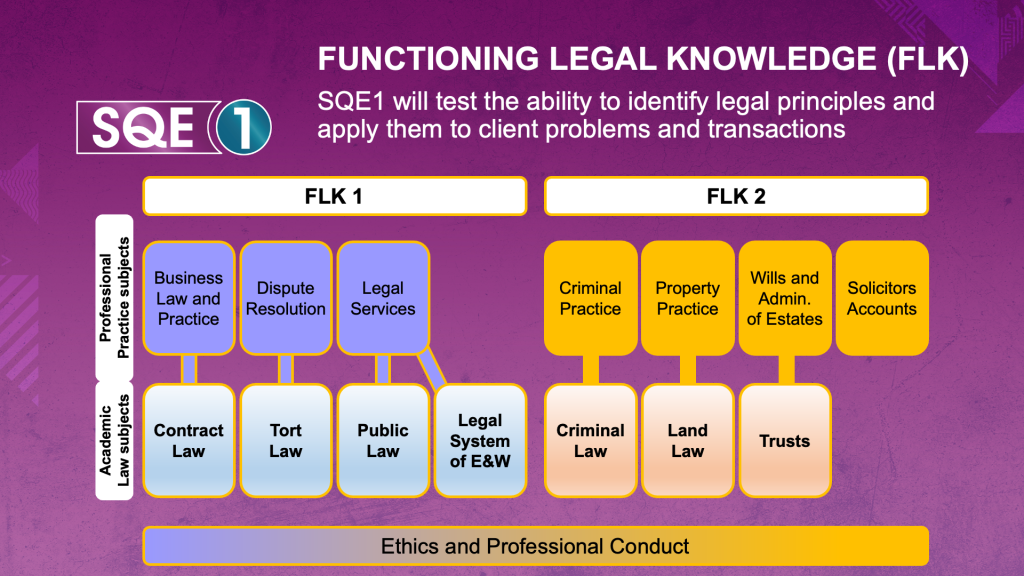
SQE1: Functioning Legal Knowledge (FLK)
SQE1 assesses your functioning legal knowledge across two assessments: FLK1 and FLK2. It tests a broad range of substantive law through multiple-choice questions based on realistic client scenarios, requiring you to identify legal issues and apply the law accurately in practical contexts.
SQE2: Practical Legal Skills
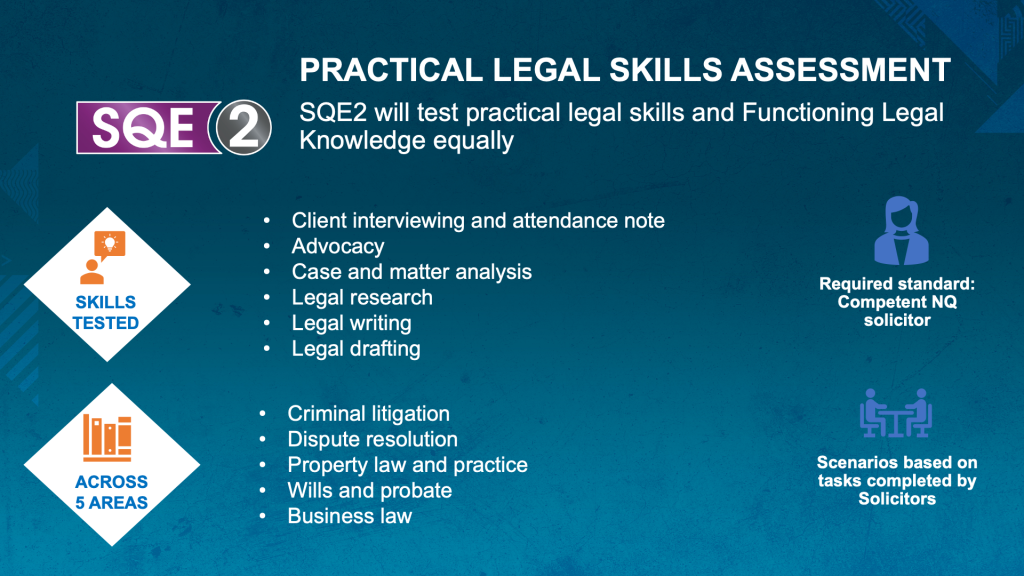
SQE2 focuses on the practical skills needed to work as a solicitor. Through a series of realistic written and oral tasks, you will be tested on skills such as interviewing, advocacy, legal research, drafting, writing, and case and matter analysis across a range of practice areas. The emphasis is on demonstrating professional competence, accuracy and sound judgment in scenarios that reflect real legal work.
SQE1 taster lesson
Daniel Cowan, Head of SQE at The University of Law, delivers an SQE1 taster session covering ethics and professional conduct. Get a flavour of what it’s like to study SQE1:
Which SQE path is right for you?
The University of Law have put together a comprehensive guide, “An SQE Course for Everyone”, with everything you need to know about becoming a solicitor, including career opportunities, courses, and funding. You’ll also find out more about the SQE assessments in detail and the difference between Qualifying Work Experience and training contracts. The guide will help you determine which path to qualifying is right for you. Read the free guide here.
Sample SQE1 questions
The SQE1 assessment includes a number of single best answer questions (SBAQs) — take a look at some example ethics and professional conduct questions to get a taste of how SQE1 is examined. You can find a vast bank of example SBAQs on The University of Law SQE App, available for free on the Apple App Store or Google Play Store. Download the app and access not just the questions, but performance data to help guide your revision.
Sample question 1: Duties to the court and third parties
A solicitor specialising in criminal litigation is engaged to represent a client charged with assault occasioning actual bodily harm.
The client tells the solicitor that he is innocent, pleads not guilty and gives evidence in his own defence at trial. The client is subsequently acquitted. After being acquitted the client approaches the solicitor and reveals his guilt, thereby showing that he committed perjury during his evidence.
Which of the following statements best describes the action that the solicitor should take?
ANSWER OPTIONS
Option A: Write to the court exposing the client’s guilt, thereby fulfilling the duty to act with integrity.
Option B: Do nothing as the knowledge of perjury was obtained after the trial, and therefore does not amount to complicity in misleading the court.
Option C: Contact the Crown Prosecution Service to ask for a retrial, thereby fulfilling the duty to uphold the proper administration of justice.
Option D: Tell the client that he must reveal his guilt to the prosecution, and that otherwise the solicitor will have to cease to act for him.
Option E: Telephone the victim of the assault to say that the client was guilty, thereby fulfilling the duty to act with honesty.
Sample question 2: Duties to the court and third parties
A solicitor is acting for a client on a plea of guilty to a charge of assault on a member of staff in a public house. At the sentencing hearing the court asks the solicitor to confirm that the client’s list of previous convictions is accurate. The client instructs the solicitor to confirm that the list is accurate despite the fact a conviction for assaulting a bartender last year has been omitted. The solicitor advises the client that this omission should be corrected, but the client does not want to do this.
Which of the following best explains what the solicitor should do?
ANSWER OPTIONS
Option A: Tell the client that the solicitor must cease to act because the solicitor cannot knowingly mislead the court.
Option B: Do as the client instructs because the solicitor’s duty to act in the best interests of the client overrides the solicitor’s duty not to mislead the court.
Option C: Continue to act but tell the court that the list is inaccurate because keeping quiet would be a breach of the solicitor’s duty to act in a way which upholds the proper administration of justice.
Option D: Correct the list and then cease to act because this accords with the solicitor’s duty to uphold the proper administration of justice.
Option E: Continue to act but refuse to confirm or deny the accuracy of the list because the solicitor will not mislead the court by remaining silent.
Sample question 3: Conflict of interests
A solicitor is asked to act by two people. One was the driver and the other a passenger in a car that collided with a truck. The two people each want the solicitor to claim compensation for them to the full extent that each is legally entitled. The driver and the passenger of the car both feel that that the driver of the truck was mostly at fault in the collision. The Police Accident Report says that the drivers of both vehicles were speeding at the time of the collision.
Will the solicitor’s professional obligations allow him to act for both the driver of the car and the passenger?
ANSWER OPTIONS
Option A: Yes, because the driver of the car and the passenger both have a claim against the driver of the truck so there is no conflict of interest or risk of such a conflict arising.
Option B: Yes, because the driver of the car and the passenger both feel that the driver of the truck was mostly at fault so there is no conflict of interest or risk of such a conflict arising.
Option C: Yes, because the driver of the car and the passenger have a substantially common interest and it would be reasonable for the solicitor to act for both.
Option D: No, because the driver of the car and the passenger have a substantially common interest but would not be reasonable for the solicitor to act for both.
Option E: No, because there is a conflict of interest or a significant risk of such a conflict arising between the driver of the car and the passenger and they do not have a substantially common interest.
Sample question 4: Confidentiality
A solicitor is instructed by a new client in the purchase of a house. One of the solicitor’s former clients sold the house to its current owner 12 months ago at a much reduced price because the house had been flooded twice in the previous three years. The new client does not know that the house is at risk of flooding.
Which of the following best describes the position with regard to the solicitor’s duty of disclosure?
ANSWER OPTIONS
Option A: The solicitor can only disclose the risk of flooding to the new client with the former client’s consent.
Option B: The solicitor must disclose the risk of flooding to the new client because the duty of disclosure takes precedence over the duty of confidentiality.
Option C: The solicitor has no duty to disclose the risk of flooding to the new client because the information is not material to the retainer.
Option D: The solicitor can disclose the risk of flooding to the new client because the solicitor owes no duty of confidentiality to the former client following termination of the retainer.
Option E: The solicitor must disclose the risk of flooding to the new client because this is in the new client’s best interests.
Sample question 5: SRA principles
A solicitor is instructed by a client in relation to a commercial contract. The solicitor attends a meeting with the other party’s solicitor to negotiate the terms of the contract. Later that day, the solicitor tells the client that they will immediately produce a written note of what was said at the meeting. The solicitor fails to make the written note.
Some months later, a disagreement arises over the implementation of one of the terms of the contract and the client believes that having sight of exactly what was said at the meeting will resolve the disagreement. The client contacts the solicitor asking for the written note.
The solicitor cannot recall the meeting in detail, but types up a note of what the solicitor thought must have been discussed and presents it to the client, dated with the date of the meeting.
Has the solicitor acted in accordance with the SRA Principles?
ANSWER OPTIONS
Option A: Yes, because the solicitor has acted honestly in taking the best course of action that they could in the circumstances.
Option B: Yes, because the solicitor’s duty to act in the best interests of the client outweighs all other considerations.
Option C: Yes, because the solicitor’s actions have saved their firm from professional embarrassment.
Option D: No, because the solicitor has not acted with integrity.
Option E: No, because the solicitor has not acted with independence.
Sample question 6: Duties to the court and third parties
A solicitor is acting for the defendant in a criminal case. The solicitor interviews a potential witness. During the course of the interview, it transpires that the witness’ evidence works against the defendant’s case.
Which of the following best describes how the solicitor’s duties apply in this situation?
ANSWER OPTIONS
Option A: The solicitor’s duty to act in the client’s best interests requires that the solicitor try to persuade the witness to change their evidence.
Option B: The solicitor is not obliged to call the witness, but the solicitor must be careful to adhere to the solicitor’s duty not to mislead the court.
Option C: The solicitor’s duty to uphold the administration of justice requires the solicitor to call the witness regardless of the evidence the witness will give.
Option D: The solicitor is under a duty to draw the court’s attention to the witness’ evidence because it is likely to have a material effect on the outcome of the case.
Option E: The solicitor’s duty to act with integrity requires the solicitor to tell the prosecution about the witness’ evidence.
Sample question 7: SRA principles
A solicitor’s husband is caught by a speed camera travelling in his car at 100 mph on a 40 mph road. The husband already has several points on his driving licence and so, to avoid the husband being disqualified from driving, the solicitor makes a false statement to the police stating that she was driving the car at the time of the speeding offence.
The solicitor has been qualified for six months and works in her firm’s commercial property department.
Which of the following statements best describes the professional conduct sanctions that the solicitor is likely to face?
ANSWER OPTIONS
Option A: The solicitor will face mild sanctions in view of her junior status.
Option B: The solicitor will face no sanctions because the SRA Principles do not apply to a solicitor’s private life.
Option C: The solicitor will face mild sanctions because speeding is a minor offence.
Option D: The solicitor will face mild sanctions for failing to uphold public trust and confidence in the solicitors’ profession.
Option E: The solicitor will face severe sanctions for acting dishonestly.
Sample question 8: Confidentiality
A solicitor is acting for the claimant in a contract dispute. Shortly before the final hearing, the defendant’s brief to counsel in the case is delivered to the solicitor’s office by mistake.
What should the solicitor do?
ANSWER OPTIONS
Option A: Read the brief and then make the client aware of any of the contents which are material to the client’s matter.
Option B: Immediately return the brief to the defendant’s solicitors without reading it.
Option C: Read the brief and then make use of its contents at the final hearing.
Option D: Ask the client for instructions on whether to return the brief.
Option E: Destroy the brief without reading it.
Sample question 9: Conflict of interests
A solicitor is asked to act in a boundary dispute. The prospective client owns a piece of land adjacent to a company’s warehouse premises. The company has recently erected a fence which encroaches onto the land. The solicitor tells the prospective client that the solicitor is on the company’s board of directors. However, the solicitor reassures the prospective client that the solicitor does not act for the company and that the solicitor will keep the prospective client’s information confidential.
Is the solicitor able to act for the prospective client?
ANSWER OPTIONS
Option A: Yes, because the prospective client is aware of the solicitor’s directorship.
Option B: Yes, because effective safeguards are in place to protect the prospective client’s confidential information.
Option C: Yes, because there is no connection between the directorship and the solicitor’s professional work.
Option D: No, because there is an own interest conflict.
Option E: No, because there is a conflict of interest between the prospective client and the company.
Sample question 10: Conflict of interests
A solicitor receives instructions to act for the claimant in a litigation matter. The solicitor’s colleague in the firm’s litigation department, already acts for the defendant in the same matter.
Can the solicitor act for the claimant?
ANSWER OPTIONS
Option A: Yes, because the parties have a ‘substantially common interest’ in the matter.
Option B: Yes, because the parties are ‘competing for the same objective’.
Option C: Yes, because there is no conflict of interest where the parties are represented by different solicitors within the same firm.
Option D: No, because there is a conflict of interest.
Option E: No, because there is an own interests conflict.
Sample question 11: Duties to the court and third parties
A solicitor has a client who is the Claimant in a road traffic collision claim. In their meeting a week before the trial, the Claimant tells the solicitor that he could clearly see both of the Defendant’s hands on her steering wheel immediately before the collision.
On the morning of the trial, the Claimant tells the solicitor in confidence that he wants the solicitor to cross-examine the Defendant on the basis that she was texting on her mobile phone at the time of the collision. The Claimant admits to the solicitor that he could not see the Defendant using her mobile phone.
Which of the following best describes what the solicitor should do at trial?
ANSWER OPTIONS
Option A: The solicitor must immediately withdraw from the case and no longer represent the Claimant at trial.
Option B: The solicitor should cross-examine the Defendant, but not on the basis that she was using her mobile phone at the time of the collision.
Option C: The solicitor should tell the Defendant’s legal representative what the Claimant said during the meeting.
Option D: The solicitor should not cross-examine the Defendant at trial at all.
Option E: The solicitor should cross-examine the Defendant on the basis that she was using her mobile phone at the time of the collision.
Sample question 12: Duties to the court and third parties
A solicitor is acting for the claimant in a litigation matter. The defendant is unrepresented. On the journey to court for the final hearing the solicitor is reading a legal journal and discovers that the solicitor has overlooked a case which completely destroys the client’s case.
What should the solicitor do on arrival at court?
ANSWER OPTIONS
Option A: Cease to act.
Option B: Provide the defendant with the name of the case and its citation.
Option C: Draw the court’s attention to the case.
Option D: Ask for the client’s consent to the solicitor drawing the case to the court’s attention.
Option E: Tell the client that the case cannot proceed because of a procedural irregularity.
Sample question 13: Conflict of interests
A father is selling one of his many properties to his daughter at a substantial undervalue to help her to get a start on the property ladder. They both ask the same solicitor to carry out the conveyancing work for them.
Which of the following best explains who the solicitor can act for?
ANSWER OPTIONS
Option A: The solicitor cannot act for either as there is a conflict of interest between father and daughter.
Option B: The solicitor cannot act for either as there is an own interest conflict.
Option C: The solicitor can act for both as they are ‘competing for the same objective’.
Option D: The solicitor can act for both as the risk of a conflict of interest is not significant.
Option E: The solicitor cannot act for the father as selling the property at a substantial undervalue is not in his best interests.
Sample question 14: SRA principles
A client instructs a solicitor to carry out the conveyancing work on the sale of a house. The client has put the house on the market for an asking price of £500,000. The solicitor thinks that the asking price is cheap. The solicitor suggests to his wife that she should buy the house. The solicitor’s wife buys the property for £500,000 and sells it three months later, making a profit of £75,000.
Which of the following best describes the professional conduct implications of the solicitor’s actions?
ANSWER OPTIONS
Option A: The solicitor did not do anything wrong because the client achieved their objective of selling the house.
Option B: The solicitor’s actions are likely to diminish public trust and confidence in the solicitors’ profession because a profit has been made at the client’s expense.
Option C: The solicitor did not do anything wrong because the client did not suffer a loss.
Option D: The solicitor acted with integrity because the solicitor did not make a profit himself.
Option E: The solicitor acted in the client’s best interests in securing the price the client wanted for the house.
SQE study manuals
To support your progress through the SQE and into your life in professional legal practice, The University of Law offers comprehensive study guides covering the Functioning Legal Knowledge (FLK) that is contained within the new assessments. The guides provide solid knowledge and understanding of fundamental legal principles and rules, while bringing the law and practice to life with example scenarios based on realistic client problems.
Each guide features thorough examples and sample assessment questions that help you check your knowledge and understanding through single best answer questions that have been modelled on the SRA’s sample assessment questions. You can buy these directly on their website.