
The Legal Cheek View
Made up of over 100 barristers, of whom an impressive 25 are KCs, Crown Office Chambers is one of the leading civil and commercial sets in the country. Due to its sheer size, the set has numerous teams, meaning barristers here have “plenty of opportunity” to spread their wings into areas outside of their traditional practices. With expertise ranging from clinical negligence claims to international commercial litigation, a tenant at the set tells us that it has an “equally strong reputation in both commercial and civil work”, something which is “incredibly rare”. This certainly makes the prestigious set perfect for aspiring barristers who have their hearts set on a varied practice.
Whilst Crown Office is perhaps traditionally best known for its insurance (especially insurer-backed), construction, and property damage work, it also has renowned expertise in inquests and inquiries, clinical negligence, personal injury, product liability, health and safety, professional negligence, criminal regulatory work, civil fraud, and contractual claims. A tenant at the set tells us: “it’s so rare for a set to be able to offer first-rate work in high-end commercial cases and in areas of common law practice. Crown Office manages to do this; it is one of only two or three sets to do so.” The “incredible” range of work looks set to expand even further as Crown Office’s arbitration practice continues to thrive, particularly international arbitration in the construction and engineering fields, with the Middle East representing a significant market. Sports law is also a growing practice area, especially since former professional cricketer Maurice Holmes joined as a tenant!
As well as being broad in range, the work undertaken by tenants at Crown Office is high in quality and interest level. One junior at the set tells us: “I am instructed on a novel professional negligence case against a silk (I am 2018 call) and on the diesel emissions litigation, the biggest ever claim before the English courts.” Another adds that the work is “endlessly fascinating. Even as a junior you can take on work that has a real impact on people’s lives.”
This is certainly the case in areas such as personal injury, clinical negligence, and insurance. Past cases include X Children v Minister for Health & Social Services, the largest personal injury claim in British legal history, in which child abuse victims in Jersey sued the Minister for Health & Social Services for £238 million, as well as the FCA test case, which concerned whether thousands of businesses could recover under their business interruption policies for losses caused by the pandemic. It is no surprise that tenants describe their work as involving “a broad range of legal and factual issues and working with interesting and stimulating people.”
Crown Office’s tenants are regularly instructed in the highest courts in the country. One junior tells us they frequently advise on “high-end sexual abuse and general personal injury litigation with multiple novel legal issues and regular outings to the Court of Appeal and occasionally the Supreme Court.” Another adds simply: “I am regularly in the High Court and above.” The work really does seem to be “varied, stimulating and intellectually demanding.” As one tenant puts it, “very rarely will I have a run-of-the-mill piece of work”, though of course “everyone has to pay their bills!” Some of the junior construction work can be a little more routine, and one baby junior notes that whilst “a lot of my own cases are fascinating”, being led on “a huge piece of litigation can throw up some tedious tasks like disclosure review.”
It is not just the KCs and senior juniors who get all the exciting work, however. One pupil described being involved in a wrongful birth case concerning novel arguments on the duty of care in secondary victim psychiatric injury claims, as well as interim hearings in commercial court cases involving complex issues of agency and an agent’s duty to deliver up client papers, including whether this duty is contractual or imposed by law. They also undertook advisory work concerning the construction of all-risks construction project insurance policies. As they put it, they were “never bored at any point, and interesting points of law arise on an almost daily basis.” It certainly sounds like a strong start to a career at the Bar.
Juniors at the set commonly maintain a broad practice early on, though one emphasises they are “not forced into areas I don’t like”, with “opportunities in the future to develop a more specialised practice.” Even senior juniors and KCs who are more specialised often find themselves covering a range of work, as many of Crown Office’s practice areas naturally overlap. The set is renowned for taking on complex cases at the intersection of different disciplines, with one insider describing their work as “cutting-edge litigation that pushes the boundaries in my areas of practice.”
The set continues to work on fascinating cases across the board. Four members (Alexander Antelme KC, David Myhill, Richard Sage and Frederick Simpson) act for Renault in the Dieselgate group litigation featuring 1.8 million claimants. Meanwhile, cases regularly throw up compelling human interest: Malcolm Galloway successfully defended a Devon farmer in a two-week jury trial after a couple were injured by cows in a field with a public right of way. On the construction side, Andrew Rigney KC and Charles Pimlott were instructed by a Knightsbridge luxury residential complex in a substantial breach of contract claim with over £50 million in damages. Junior Nadia Whittaker successfully defended a surgeon against an informed consent claim worth £4 million, and David Platt KC and Peter Houghton represented the Ministry of Defence in the military deafness litigation before the High Court, where around 5,000 current and former armed forces claimants sought damages for hearing loss. The variety means you might be instructed in a case featuring contentious international law or novel medical questions one day, and cows the next.
“The only risk in my experience,” one junior tenant tells us on the subject of work/life balance, “is of having too much excellent quality work, which is a great risk to have!” Whilst balance at the Bar is ultimately a matter of individual choice, several tenants note a “strong awareness of the need for a sensible balance” at the set. One member says this translates into “flexibility allowing me to take breaks from work whenever needed, whether that is micro breaks or longer holiday-type breaks.” Another adds: “The clerks are very understanding and supportive and I have never had to sacrifice an important personal commitment for the sake of work.” In short, it is “very much a matter of personal choice. The clerks do not put pressure on.”
During pupillage, pupils are “kicked out” at 6pm “pretty much every day”, with supervisors keen for them not to stay late or bring too much work home, assessment periods aside. One former pupil recalls rarely having to work weekends unless an assessment was under way, adding: “Once you are into tenancy, it is really up to you how much or how little work you wish to take on. Some tenants take a month off over the summer; others prefer to bill as much work as possible.”
A real advantage at Crown Office is that both clerks and fellow barristers are “very supportive”, with colleagues who give their “time and energy selflessly.” One tenant, having previously been at two other sets, describes their Crown Office colleagues as “certainly the most supportive I have met.” One baby junior credits this culture with allowing them to build their practice quickly and to “graduate to serious and interesting cases much earlier in my career than I was expecting.” There is a “real camaraderie” and “generosity of spirit among colleagues”, with an open-door policy throughout. One junior explains: “everyone is always willing to help with any work queries or any matters about work/life balance and life in general. The general rule is we always stop what we are doing if someone needs to ask a question.” There is also a “hive mind” group chat used to test arguments and canvass views on procedural and legal problems.
As well as being collegial, the Crown Office crowd are “extremely social.” We hear that there are informal lunches and Friday night drinks, networking events with solicitors, an annual Christmas party, and formal dinners to celebrate occasions such as retirements, all contributing to a “generally high-spirited collegiate atmosphere.” Recent chambers events with solicitors have included clay pigeon shooting, a ladies’ lunch, and a trip to Royal Ascot. One junior says: “compared to other chambers, we’re known as enjoying a party. We work very hard and the ‘work hard, play hard’ cliché definitely applies here.” The set even has its own in-house bar for fortnightly drinks.
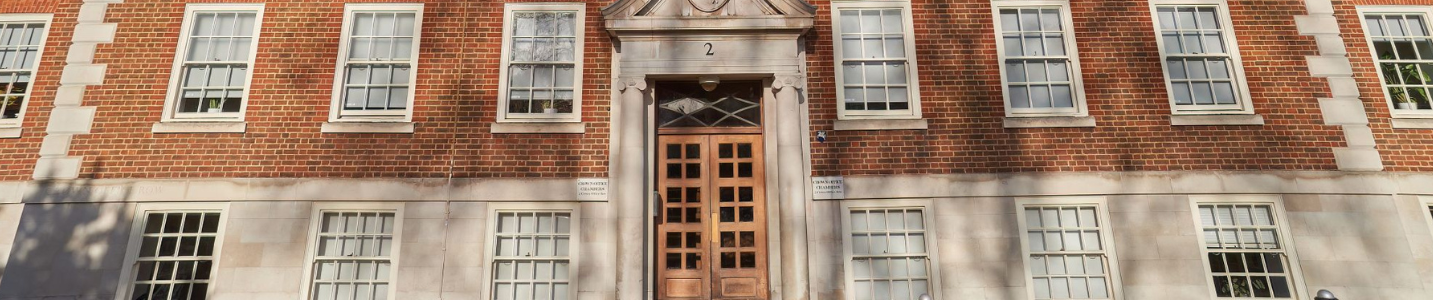
Crown Office’s premises are located opposite Inner Temple Gardens. The views over the gardens and the Thames lead one member to describe “the setting as among the best in London”, while next-door competitors are, as one wry observer notes, “overlooking the car park.” Inner Temple’s Pegasus Bar is also conveniently located next door. The set’s “beautiful” building features traditional Temple architecture refreshed by a recent interior redecoration, with a brand-new modern reception, common room coffee machines, and well-equipped conference rooms ensuring the “outside and public areas are as impressive as you could hope.” As one barrister puts it: “fresh refurb inside, towel service in the showers, five-star stuff.”
On the technology front, conference rooms feature “state of the art” equipment, and tech support from an external provider is available around the clock. The set also benefits from a dedicated digital clerks team who produce what one barrister calls “the most amazing digital bundles”, describing the capability as “literally unparalleled.” Even so, one insider concedes that outsourced support, whilst “pretty good”, can be “occasionally frustrating.”
Crown Office Chambers offers up to four pupillages a year. In the first six months, pupils sit with two different supervisors for three months each. Work is predominantly completed for these supervisors, though pupils are also likely to receive work from a range of tenants, broadening their knowledge base. In their second six, pupils sit with a third supervisor and begin receiving regular instructions in their own right. They can expect to appear in court up to three or four times per week, making applications and conducting small trials, particularly in the county court, with the chance to appear in larger cases and even international courts.
Pupillage at Crown Office is highly regarded. One former pupil says: “my pupil masters were all I could hope for, and they still maintain a supportive relationship with me even more than a decade later.” Another admits that whilst “pupillage is a weird and Victorian process”, it “couldn’t be done better than it is here.” As well as their supervisors, pupils are given a mentor, typically a junior barrister who helps them learn the ropes. One recent pupil reflects: “compared to friends at other sets, my pupillage was an enjoyable experience. The chance to be on your feet is invaluable. Not only can you earn money on top of the already generous pupillage award, but you also develop real advocacy skills, putting you way ahead of pupils at other sets who have spent six months doing paperwork.” Beyond pupillage, the set offers an “excellent array of in-house training”, including equality and diversity training. One insider emphasises that their “three pupil supervisors really put an enormous amount of effort into making sure I was fully equipped to engage in a successful and rewarding practice pretty much from the moment I was on my feet.”
Those wishing to apply for pupillage at Crown Office Chambers should do so through the Pupillage Gateway. Around 32 applicants will be invited to a first-round interview, typically conducted in front of two tenants and general in nature. Around 15 candidates will then be invited back for a more extensive final-round interview before a panel including KCs. Before entering the interview room, candidates are given a legal problem to prepare over approximately 30 minutes, which they then present. General and ethics questions are also posed.
Crown Office assesses applicants on intellectual ability, analytical skills, sound judgement, oral and written advocacy, interpersonal skills, integrity, organisational skills, determination, and an interest in the set. It uses RARE’s contextual recruitment scheme to assist in sifting written applications at the first round, placing each candidate’s achievements in their wider context. The set is committed to equality of opportunity and participates in initiatives including Access to the Bar, the Pegasus Access and Support Scheme, and Inspiring the Future.