

Neurodivergent candidates outperform counterparts in SQE1 and SQE2

Candidates with neurodivergent conditions who sat the SQE with reasonable adjustments in place slightly outperformed their peers across all stages of the assessment, according to a new analysis of exam performance data published by the Solicitors Regulation Authority (SRA).
The report examines results from SQE1 and SQE2 sittings between September 2024 and July 2025, focusing on candidates who received a reasonable adjustment for a disclosed neurodivergent condition. These include autism, ADHD, dyslexia, dyspraxia and dyscalculia, as well as candidates with multiple conditions.
The analysis looks exclusively at first-time sitters, covering two sittings of each SQE1 paper (FLK1 and FLK2) and four sittings of SQE2. Of the 26,744 candidate assessments included, 5.6% included candidates with a reasonable adjustment plan for a neurodivergent condition.
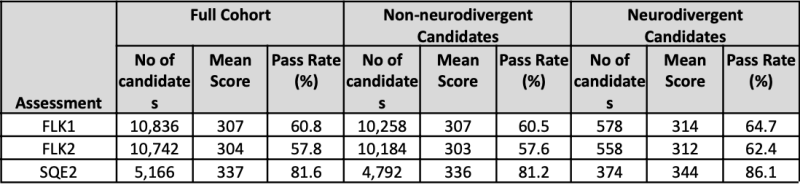
The report found that neurodivergent candidates achieved higher mean scores and pass rates than those without such conditions across the board. In FLK1, candidates with neurodivergent conditions received average scores of 314 and a pass rate of 64.7%, compared with a mean score of 307 and a pass rate of 60.5% for non-neurodivergent candidates.
Similar patterns were seen in FLK2, where neurodivergent candidates achieved a mean score of 312 and a pass rate of 62.4%, versus 303 and 57.6% respectively.
The trend continued in SQE2. Neurodivergent candidates achieved a mean score of 344, with an 86.1% pass rate, compared with a mean score of 336 and a pass rate of 81.2% among other candidates.
Despite the clear performance gap, the report advises against drawing definitive conclusions by comparing the two groups directly. Candidates with neurodivergent conditions make up a relatively small proportion of the overall cohort (5.3% of FLK1 candidates, 5.2% of FLK2 candidates and 7.2% of SQE2 candidates) and are “not fully representative” of the wider population in terms of other characteristics that may influence performance, such as age, ethnicity, sex and socio-economic background.
Even so, the SRA says the overall picture should reassure candidates. The report concludes that candidates with neurodivergent conditions are not disadvantaged by the SQE, with their performance “not below that of candidates without these conditions”.
The report also gives a more detailed view of the data. When results were divided into quintiles, the boundaries between neurodivergent and non-neurodivergent candidates were found to be very similar, with all quintiles overlapping across the two groups in FLK1, FLK2 and SQE2.
 (
( (
(