
As technology advances at pace, Lord Reed tells Legal Cheek that the profession has a greater duty than ever to uphold trust in the legal system
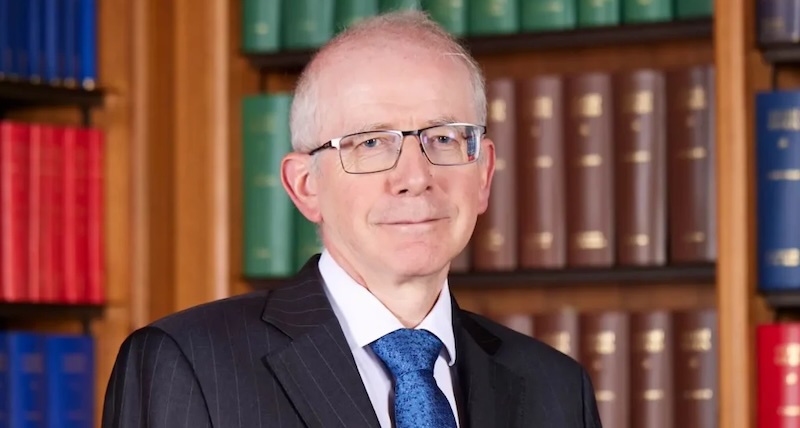
AI is a “public trust” issue for the courts, Lord Reed told a packed courtroom of students at a panel event at the Supreme Court, warning that it could threaten trust as much as populism.
Speaking alongside experts, linguistics professor, Claire Hardaker, and research director with Ipsos Mori, Daniel Cameron, the President of the Supreme Court warned that, as the UK’s justice system explores how and to what extent it should use AI, perhaps even to make judicial decisions, we should tread very carefully. “If you are studying law, you’ll appreciate that difficult legal questions don’t lend themselves to a computerised binary response — and these can be issues of enormous impact,” Lord Reed said.
Reminding the audience of the 87-page decision the Supreme Court had to produce to define the word, ‘woman’ in the For Women Scotland case published last year, arguably the most important decision made during Lord Reed’s presidency, he said: “This requires judgement and there is no mathematical solution.”
Giving another hypothetical example of a dispute over a child in a family law case, he said: “If that went against you, and it was AI that decided it, would you have trust in the legal process? I suspect you wouldn’t.” He concluded: “If we don’t have proper checks [on AI], we could destroy trust.”
These concerns come at a time when courts are already facing growing hostility driven by populism, something Lord Reed has previously highlighted through increased criticism in the media and on social platforms.
At the panel discussion, he expanded on this, citing the shocking recent events in Minnesota, as an “extreme form” of where there is lack of trust and respect for the law. “We see concerning trends in politics in other countries, that adherence to the law and respect for courts is quite liberally denigrated,” he said. “The judicial decisions of [the actions of] the executive are seen as ‘political interference’ by ‘unelected’ judges.’”
“Leaders try to eliminate independent courts through political influence over appointments, justifying it as a way of making government more effective and responsive to what people want,” he continued. But the effect is, Lord Reed argued: “To diminish respect for the law — which one can see in extreme form lately by people being shot in the streets by government officials with apparent impunity.”
Speaking to Legal Cheek after the event, Lord Reed continued this theme. He said lawyers have a role to play to bolster trust and understanding of our legal system. “They are ambassadors for the court and for the law, a bridge between courts and the public,” he told us. “When politicians say they don’t like a judgment, lawyers can stand up and explain how complex and difficult these things are.”
“They know this to be true because they have studied hard for a long time!” he quipped.
The good news is that public trust in the Supreme Court seems to be reasonably high (so far) according to an Ipsos Mori poll. It found that 59% of those asked (back in 2022), had a fair amount or a good deal of confidence that our top court will do its job well (though it also found that only around 30% were familiar with what the Court does).
Of course, AI is not only a trust issue. Lord Reed raised the problem that AI is owned by “a small number of companies collected in one country only, which gives rise to problems on how to regulate it.” The panel also discussed problems of deep fake, AI’s ability to be easily ‘poisoned’ by a hostile state, and the dangers created simply by the way it learns.
Professor Hardaker put it like this: “AI is designed to be inherently people pleasing. It always asks you, doesn’t it, if you would like the information put into a presentation or document. You are training that system not in accuracy but in validation. It becomes plausible and convincing but not trustworthy.”
Cameron told the audience that the public has conflicting feelings about AI. “[T]he British public loves surveillance,” he said. “But they are really concerned that AI will replace human judgment and decisions.” And so that extent, it looks as if the public shares Lord Reed’s reservations.
 (
( (
(