

Final year law student Talia Adanna looks at Kylie Jenner’s latest collab
With a combined social media following of over 454 million, the billionaire sister to mega star Kim Kardashian has figure headed the influencer economy for over a decade. Do I even need to introduce her? You already know the name, it’s Kylie Jenner. (King Kylie if you’re an internet-aholic like myself.)
Love her or hate her, you cannot deny her influence. In fact, she was an influencer before it was even really a thing. So much so that marketing execs have dubbed her dominance ‘the Kylie Effect’. In 2018, Jenner was one of Snapchat’s most-viewed individual users, and a single tweet from her was enough to send shockwaves through the platform.
sooo does anyone else not open Snapchat anymore? Or is it just me… ugh this is so sad.
— Kylie Jenner (@KylieJenner) February 21, 2018
Just like that, $1.3 billion was wiped from the app’s market valuation in one day.
Then, a year later, Jenner set the world record for the most liked post in Instagram history.
It’s important to be aware that despite her immense success and popularity across social media platforms, Jenner has repeatedly described her relationship with social media as a major source of anxiety, frequently expressing how participating in her family’s reality show and living under intense public scrutiny since childhood has negatively impacted her mental health.
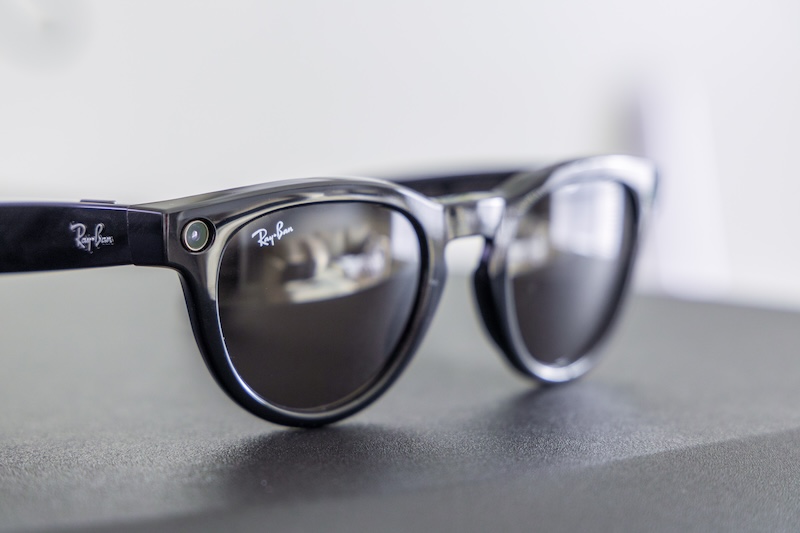
The mogul has incredible influence on which products trend, sell out and completely flop, with approximately 70% of her combined followers being female. So, imagine the impact of her public endorsement of her very own fashionable camera-enabled accessory – Meta glasses.
Picture this: Your favourite TikToker is recording a ‘day in the life’. We watch the world through their eyes as they brush their teeth with a new whitening toothpaste, walk to the kitchen of their gorgeous, high-rise apartment and take us through the steps of their morning matcha, with the luxury of not having to hold or prop up a phone or ringlight. As their day continues, they bring us along to run errands.
Want to write for the Legal Cheek Journal?
Find out moreAnd at this point you’re wondering, what’s the matter? This seems totally harmless! And it is. Until they step outside. They record countless unsuspecting individuals and interactions, potentially without their knowledge.
So, Kylie’s glasses begin to follow the pattern of every other product she endorses; they trickle down into the influencer sphere, which we can observe in real time, before landing in the hands of everyday people. Is this the point that we can mark the end of public privacy?
The collaboration raises important ethical questions. Zuckerberg and Jenner are both high-profile entrepreneurs in their own rights, appearing on the cover of Forbes and holding significant cultural influence. Meta is likely to be aware of the growing anxiety among consumers surrounding the wider rollout of these glasses, particularly concerns about privacy, consent and the potential for misuse while the law continues to catch up. Against this backdrop, the brand’s million-dollar collaboration with Jenner is notable, given her substantial global influence, particularly among female consumers.
The rise of ‘Meta glasses’ has attracted growing criticism on social media, particularly around privacy and the possibility of people being recorded in public without their knowledge or consent. The glasses offer a wide range of features, including real-time captions during conversations, information about unfamiliar foods on a menu and technology that can analyse facial and vocal information. While these features can offer practical benefits — from navigating an unfamiliar city to identifying potential allergens in a meal — critics have also raised concerns about how increasingly sophisticated wearable technology could be misused, particularly as facial recognition, deepfakes and other forms of digital identification continue to develop.
A recent BBC report highlighted the experiences of two women who said they were unknowingly recorded in public using smart glasses before the footage was posted online, where they subsequently received sexualised comments and harassment. One of the women “reported the incident to Sussex Police, but was told there was nothing they could do, as it is not illegal to film people in public”.
Want to write for the Legal Cheek Journal?
Find out moreAcross the legislation of England and Wales, there appears to be limited provision specifically addressing this aspect of digital safety and privacy. Meta glasses have been sold in the UK since 2021, but despite growing concerns around deepfakes, non-consensual recording and other forms of digital harm, there remain relatively few clear legal mechanisms designed to address these situations directly. Take recent legislative updates, like the Data Protection Act 2018 and 2022 upskirting laws, which target specific sexual offences but fail to address covert, non-explicit surveillance in public spaces.
Even the heavily anticipated Online Safety Act 2023, which finally criminalised the sharing of non-consensual intimate deepfakes, contains a massive regulatory loophole. It punishes the sharing of explicitly sexual material online, but completely fails to address the initial, covert recording of unsuspecting individuals by eye-level wearable technology in public spheres. This leaves a massive regulatory gap.
Under Section 67 of the Sexual Offences Act 2003, voyeurism strictly requires the victim to be engaged in a ‘private act’ (such as undressing or using a restroom). Because walking down a public street does not meet this threshold, traditional voyeurism legislation is completely powerless against eye-level, wearable surveillance technology in public spaces.
The harms that these things inflict are digital, instantaneous, and most importantly, unprecedented. There is minimal case law to look towards, forcing the judiciary to iterate upon the law as they go, a process known as ‘incrementalism’. Although this is how the common law has always worked, we must evaluate this process critically.
Grassi and Bolta’s report about ‘Himpathy in Sexual Assault Trials’ explores how gendered assumptions can shape decision-making in sexual assault cases. That does not mean every judgment is biased, of course, but it does raise an uncomfortable question: what happens when judges are asked to apply old legal rules to harms the law never really anticipated?
That is exactly the problem with emerging forms of digital abuse. Courts are often left reaching for familiar categories like defamation, privacy and harassment, even when they are not a perfect fit. Harassment, for example, generally requires a ‘course of conduct’, meaning repeated behaviour. Civil defamation claims involving deepfakes can also be expensive, complex and hardly offer the kind of immediate protection a victim might hope for. Meanwhile, filming in public can fall outside some existing privacy protections, depending on the circumstances.
In other words, the law can adapt (it always has) but it tends to do so one case at a time. Technology, unfortunately, does not have the same patience. Digital sexual harms are evolving at speed, while the legal framework is still trying to work out which existing box they belong in.
This compounding structural lag within our courts and legislature leaves victims entirely stranded in a digital wild west. I, like many women am massively unimpressed and afraid of the legal system’s failure to protect women from sexual harms. Of the 17% of women who do report sexual assaults, only 1% of them see their abuser criminally convicted. When these existing, abysmal figures are compounded by a sudden influx of covert, hyper-accessible recording technology, the barrier to justice grows exponentially higher. If the state cannot successfully prosecute overt, physical harms, it stands zero chance against frictionless, digital violations.
Want to write for the Legal Cheek Journal?
Find out moreWhile the Government argues that existing statutes governing voyeurism and public distress suffice, the reality on the ground tells a very different story. Private businesses have already grown tired of waiting for legislative clarity. In a stark showcase of state complacency, major UK hospitality giants, including JD Wetherspoon, ATG Theatres, and Soho House, have taken matters into their own hands by implementing blanket bans on wearable smart tech within their premises.
When commercial pubs and theatres are moving faster to protect individual privacy than Westminster, the regulatory vacuum becomes impossible to ignore. It is a glaring admission that our legal framework is entirely unequipped for the modern era. The law cannot continue to treat wearable surveillance as a minor novelty. Until statutory boundaries explicitly catch up to corporate influence, the ‘Kylie Effect’ will continue to outpace the rule of law, leaving public privacy entirely unprotected.
Talia Adanna is a final-year law student at the University of Birmingham with a deep interest in human rights law and education in emergencies. Combining her legal advocacy with creative storytelling, she is also a children’s author and a global education advocate, working as an Ambassador for Theirworld and the World Literacy Foundation to fight for children’s right to education globally.