

New mother Natasha Bassett shares how Ireland’s IVF laws have left her son in a legal limbo
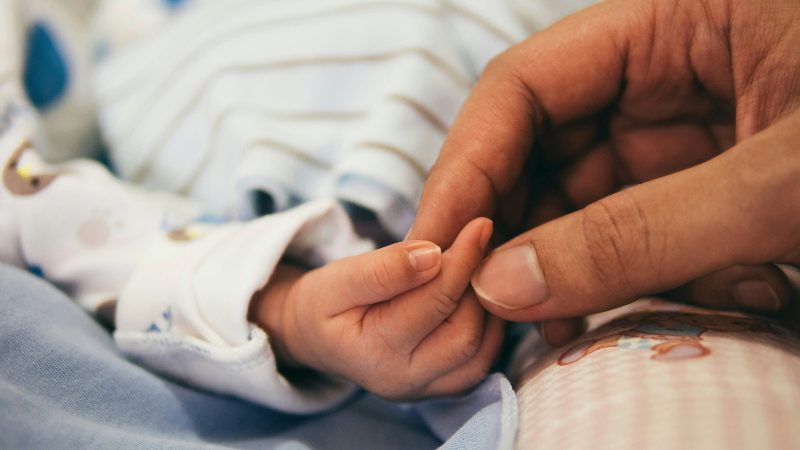
My baby has a big old Irish head on him (so says my wife, who was born and raised in Ireland, and therefore claims she’s allowed to make such jokes). He has a beautiful Irish name that invariably becomes mangled in English people’s mouths. He’s watched, or valiantly slept through, Gaelic football games at the local Irish pub, dressed in the white and red of County Tyrone, where his grandad is from. And when he was born, his Irish grandma joked that we should uphold the tradition of emigrants from Ireland: bringing a Tupperware of Irish soil to the hospital so his first step could be on the Emerald Isle.
We didn’t pack the Tupperware in our hospital bags, but maybe we should have, given we are currently compiling evidence to support our baby’s passport application. An application which might be refused. The reason this isn’t straightforward comes down to a distinction the law hasn’t quite caught up with.
Shared motherhood and the law
We need to start with an understanding of reciprocal IVF, or shared motherhood. This is a form of donor-assisted fertility treatment, when an embryo created from the egg of one mother is implanted in the other mother. In our case, my wife provided the egg and I carried our son: she is his genetic mother, I am his gestational mother. Modern science!
So, given that section 7(1) of the Irish Nationality and Citizenship Act 1956 provides for citizenship by descent, you might assume (as we did) that a child born abroad to an Irish parent, who was themselves born on the island of Ireland, would therefore be Irish from birth. And, under UK law, there is no question that my wife is our child’s parent. The birth mother is automatically the legal mother and her spouse is recognised as the child’s second legal parent, unless they did not consent to the treatment. UK nationality law can recognise that second female parent too, including where the child is born abroad. In other words, UK law has found a way to deal with the fact that the genetic and gestational mother might, in fact, be two different people.
But riddle me this: if we have another child, where my wife is the gestational parent and I am the genetic parent, they could have a much easier route to Irish citizenship than their brother, despite having no genetic connection to their Irish mother.
This is because being a legal parent under English law does not necessarily translate to Irish citizenship law. In A, B and C v Minister for Foreign Affairs and Trade [2023], the Irish Supreme Court considered the meaning of ‘parent’ in section 7. The case involved a same-sex male couple living in England and a child born through surrogacy. Although the Irish citizen spouse was recognised as a ‘parent’ in England, the Supreme Court held that this did not necessarily make him a ‘parent’ for the purposes of Irish citizenship. In interpreting section 7, the majority identified the genetic father and the birth mother as parents.
Want to write for the Legal Cheek Journal?
Find out moreBut what about when the genetic mother isn’t the birth mother?
In X and Z v Minister for Foreign Affairs [2025], Ms Justice Siobhán Phelan considered two families caught in this legal grey area. In one, the Irish citizen was legally recognised as a parent in Australia, but was neither the genetic nor gestational mother. Justice Phelan held that section 7 could not simply be stretched to include her: that was a change for the Oireachtas (the Irish Parliament) to make.
The second family was different, and very similar to mine. The Irish citizen was the genetic but not the gestational mother, and both women were recognised as parents in Spain. Justice Phelan distinguished this from A, B and C: crucially, this Irish mother was genetically related to her child. She held that the Minister had been wrong to exclude a genetic mother — who was recognised as a parent under the law of the child’s domicile — from ‘parent’ under section 7.
Her reasoning went further than that individual finding. Justice Phelan also concluded that the absence of a legal route for children born to same-sex couples through donor-assisted reproduction created unequal treatment when compared with children born through comparable arrangements in Ireland, or to mixed-sex couples abroad. She found that this was contrary to the equality clause at Article 40.1 of the Irish Constitution: ‘All citizens shall, as human persons, be held equal before the law.’
But we shouldn’t necessarily expect an Irish passport through the post any time soon. The State has appealed the decision to the Supreme Court, contending that the High Court’s interpretation is “novel and without precedent” and runs contrary to the vast majority, if not all, prior precedent. The State also argues that the decision creates uncertainty around who exactly counts as a parent in cases involving assisted reproduction, including when a genetic mother qualifies, and whether a child could end up with more than one mother or more than two parents for citizenship purposes. The appeal was heard last December, and the Supreme Court has reserved judgment.
Want to write for the Legal Cheek Journal?
Find out moreIs this just an old law producing a discriminatory result for same-sex families? It certainly feels like it on a personal level. But there is an interesting and important legal argument here: what can judges legitimately do when legislation written decades ago clashes with forms of parenthood its drafters never anticipated? And approaching a decades-old statute on a case-by-case basis risks producing yet more uncertainty. Arguably, this is a problem which the Oireachtas, rather than the courts, should ultimately solve.
But refusing to recognise genetic but not gestational mothers as parents leaves an uncomfortable question. A, B and C identifies the genetic father as a ‘parent’ for the purposes of section 7. So, if the genetic link is enough to make an Irish man a ‘parent’, why shouldn’t the genetic relationship between an Irish woman and her child be treated equivalently?
Solutions?
The Irish Ggvernment does, at least, seem to recognise that there is a problem. The Health (Assisted Human Reproduction) Act 2024 is intended to modernise the law around assisted reproduction and surrogacy. Section 226 of the Act inserts a new section 11A into the Irish Nationality and Citizenship Act 1956, dealing specifically with citizenship for some children born through donor-assisted fertility treatments and surrogacy.
The snag is that section 11A hasn’t been commenced. And, even if it were, it still wouldn’t provide a complete answer for families like mine, as it does not explicitly deal with reciprocal IVF undertaken overseas.
However, the government now appears to accept that this gap needs bridging. Its proposed Health (Assisted Human Reproduction) (Amendment) Bill includes provisions aimed specifically at parentage and citizenship problems arising when Irish citizens living abroad use donor-assisted fertility treatment overseas. The plans include a route for Irish citizens living abroad to ask the Irish courts to recognise parentage already established in another country. In other words, while the courts are being asked to work out what a law written in 1956 means today, the Irish Government is preparing legislation to deal with the gap that law has left behind.
In the meantime, however, children’s passport applications are still being refused. Two further challenges reached the Irish High Court earlier this year, including one involving an Irish genetic mother whose wife carried their child following reciprocal IVF at a UK clinic. In other words, a family in a remarkably similar position to mine.
And the riddle from the beginning? If we have another child, we plan to swap roles: I would provide the egg and my Irish wife would carry the pregnancy. That child would have no genetic connection to their Irish mother; however, their claim to Irish citizenship would be considerably more straightforward than their brother’s. Which doesn’t feel right. Or, alternatively, if I carry, I’ll be hopping on a plane to visit my parents-in-law — as a British citizen, I would fall within the Irish nationality rules entitling a child born on the island of Ireland to Irish citizenship where one parent is Irish or British. Make it make sense.
Want to write for the Legal Cheek Journal?
Find out moreConclusion
So, we wait. The Supreme Court has heard the arguments, reserved judgment, and given no indication of when it will rule. Somewhere in that judgment will hopefully be an answer to a question the drafters of the 1956 Act never had to consider: whether an Irish woman can be her child’s genetic mother but not their gestational mother, and be their ‘parent’ for the purposes of citizenship law.
Until then, my son’s Irishness sits in a legal limbo. His big Irish head, his wonderful Irish name, his wearing of his grandad’s county colours, the soil we didn’t manage to bring to the hospital: none of his Irishness is in question, at least to us. What’s in question is whether decades-old statutory language can stretch to hold a family like ours, which was lovingly formed in a way that simply wasn’t medically possible when the law was written.
I’d like to think it can. And I hope he’ll have his passport, and official confirmation of his citizenship, before he’s old enough to know there was ever such a debate.
Natasha Bassett has a background in education and an interest in law, particularly how it is shaped by real-world complexity and, in turn, shapes society, institutions and individuals.