
Neurodivergent students not disadvantaged in the SQE, report finds

Avatar photo

By Julia Szaniszlo on

4

Neurodivergent candidates outperform counterparts in SQE1 and SQE2


Candidates with neurodivergent conditions who sat the SQE with reasonable adjustments in place slightly outperformed their peers across all stages of the assessment, according to a new analysis of exam performance data published by the Solicitors Regulation Authority (SRA).

The report examines results from SQE1 and SQE2 sittings between September 2024 and July 2025, focusing on candidates who received a reasonable adjustment for a disclosed neurodivergent condition. These include autism, ADHD, dyslexia, dyspraxia and dyscalculia, as well as candidates with multiple conditions.

The analysis looks exclusively at first-time sitters, covering two sittings of each SQE1 paper (FLK1 and FLK2) and four sittings of SQE2. Of the 26,744 candidate assessments included, 5.6% included candidates with a reasonable adjustment plan for a neurodivergent condition.

The report found that neurodivergent candidates achieved higher mean scores and pass rates than those without such conditions across the board. In FLK1, candidates with neurodivergent conditions received average scores of 314 and a pass rate of 64.7%, compared with a mean score of 307 and a pass rate of 60.5% for non-neurodivergent candidates.

Similar patterns were seen in FLK2, where neurodivergent candidates achieved a mean score of 312 and a pass rate of 62.4%, versus 303 and 57.6% respectively.

The trend continued in SQE2. Neurodivergent candidates achieved a mean score of 344, with an 86.1% pass rate, compared with a mean score of 336 and a pass rate of 81.2% among other candidates.
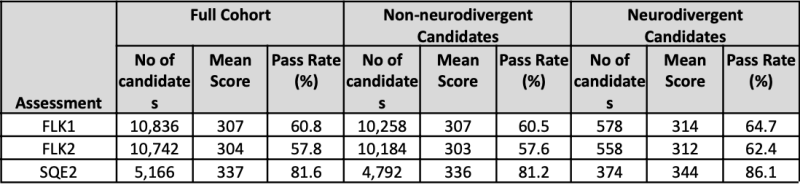
SQE mean scores

Despite the clear performance gap, the report advises against drawing definitive conclusions by comparing the two groups directly. Candidates with neurodivergent conditions make up a relatively small proportion of the overall cohort (5.3% of FLK1 candidates, 5.2% of FLK2 candidates and 7.2% of SQE2 candidates) and are “not fully representative” of the wider population in terms of other characteristics that may influence performance, such as age, ethnicity, sex and socio-economic background.

Even so, the SRA says the overall picture should reassure candidates. The report concludes that candidates with neurodivergent conditions are not disadvantaged by the SQE, with their performance “not below that of candidates without these conditions”.

The report also gives a more detailed view of the data. When results were divided into quintiles, the boundaries between neurodivergent and non-neurodivergent candidates were found to be very similar, with all quintiles overlapping across the two groups in FLK1, FLK2 and SQE2.


The SQE Hub: Your ultimate resource for all things SQE

4 Comments

Anon

“the report advises against drawing definitive conclusions by comparing the two groups directly”

Quite right, it’s time for a comprehensive report where the whole range of variables can be considered together, rather than all the piecemeal bits of data that we seem to get.

BSNQ

As someone with a ‘neurodivergent condition’, I can’t say that I am surprised. Typically a skillset of these conditions, particularly Autism, is the ability to remember answers to multiple choice questions more so than being able to answer a problem question.

Therefore, the SQE is probably a better exam style for those with neurodivergent conditions. However I can personally only speak for Autistic persons.

I would also be interested to see if those individuals get breaks as part of their reasonable adjustment plan, or even if the exam is spread over 4 days rather than 2. Which is somewhat an unfair advantage. Especially when you can get an ADHD diagnosis in a week, and then request reasonable adjustments for the exams.

Dissent

I’m not completely sure that’s right. I have autism (combined with ADHD) and it helps a lot with problem solving and pattern recognition (which is useful for comparing fact patterns by analogy) — memorisation is not a key autistic strength unless it’s your special interest (for non autistic people, a ‘special interest’ refers to the topic that an autistic person gets very interested in e.g. stereotypically, trains and dinosaurs – but obviously can be a lot of other things). The reason why an autistic person would like SQE1 is that it uses strict logic and deductive reasoning from first principles. Everyone gets the memorisation done come exam day. Also, let’s not forget the report finds better performance in SQE2 as well, so if your argument is that the reason for the study’s results overall is better MCQ ability, then it is wrong in any event. Also try having ADHD before saying a ‘rest break’ is an unfair advantage, ADHD being the disability which makes it actively distressing to have to sit still for prolonged periods of time (due to lower dopamine transmission in the prefrontal cortex resulting in severe difficulty suppressing e.g. the natural impulse to move around). As an ADHDer I’m honestly just glad we get standing desks during the TC (which half fixes the problem).

Non negotiable

Online assessments for some neurodiverse conditions are somewhat discriminatory and impacts.Also depends on the individual .
I find most students do not attempt it due to burnout ,anxiety and pressure impacting on mental health.I tried and failed .Tried other career options due to burnout

Join the conversation

Related Stories