

Skip to content

Just over half of students pass latest SQE1 sitting

Avatar photo

By Legal Cheek on

8

53%


Just over half of candidates sitting the first part of the Solicitors Qualifying Examination (SQE1) passed in the latest sitting, new figures show.

According to the Solicitors Regulation Authority’s statistical report, published yesterday, 53% of candidates achieved a passing mark in the January 2026 sitting. First-time sitters fared better, with 58% passing overall.

The result marks a recovery from the record low of 41% recorded in July 2025, when the high proportion of re-sit candidates was cited as a key factor in the poor pass rate.
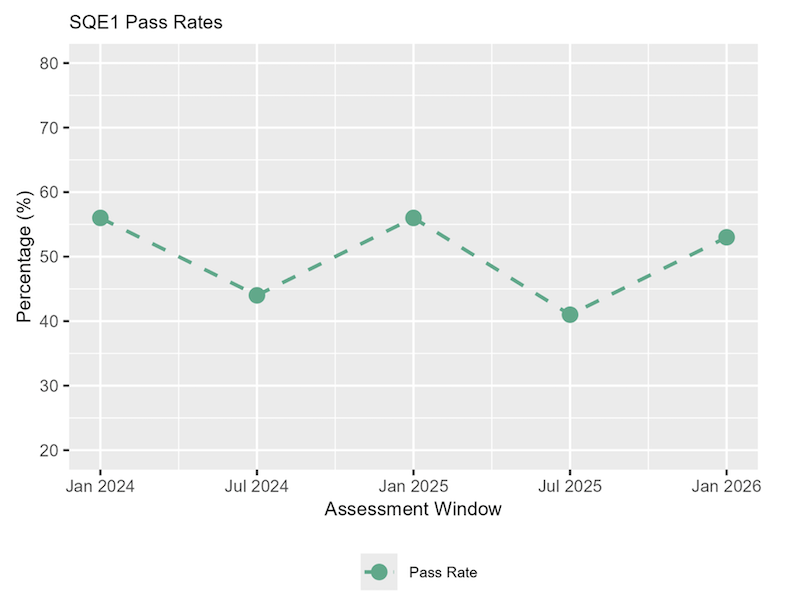
Credit: SRA

Candidates must pass both of SQE1’s two papers, Functioning Legal Knowledge 1 and 2, to pass the assessment overall. FLK1 recorded a pass rate of 62% and FLK2 57% in the latest sitting.

The report also includes a detailed breakdown of results by candidate background. White candidates passed at a rate of 67%, compared to 47% for Asian or Asian British candidates and 38% for Black or Black British candidates.

Students from fee-paying schools passed at 71%, against 57% for those from non-selective state schools.


The SQE Hub: Your ultimate resource for all things SQE
guest

8 Comments
Oldest
Newest Most Voted
Inline Feedbacks
View all comments
Anon Truth Teller
Anon Truth Teller
15 days ago

requesting a formal parliamentary inquiry to address what I believe constitutes systemic discrimination embedded deep within the structure of legal qualification and recruitment in England and Wales against neurodivergent people (protected under the Equality Act 2010).
Areas for inquiry:
1. Qualification and Assessment
The SQE in its current form disproportionately disadvantages neurodivergent candidates. Timed, high-pressure, standardised testing does not measure legal ability. It measures the capacity to perform under unfair conditions that are inherently hostile to autistic and ADHD minds. Reasonable adjustments as currently offered are cosmetic. Extra time does not address the fundamental unsuitability of the assessment model itself. We need genuinely alternative assessment pathways, portfolio-based, competency-demonstrated, neurodiverse-aware, for candidates with recognised disabilities. These should be developed in consultation with experts and specialists into neurodiversity and different cognitive styles. The format must be different from the start not with adjustments as an afterthought. The exam must be designed in good faith with the neurodiverse community in mind.
2. Work Experience and Networking
The informal pipeline into law, vacation schemes, open days, networking events, relationship-based referrals, structurally excludes neurodivergent candidates who cannot mask effectively in social performance environments. This is discrimination by design. A formal inquiry should examine how work experience gatekeeping and networking dependency constitute barriers that no reasonable adjustment addresses effectively. The concept of reasonable adjustment should be reformed to constitute alternative procedures and protocols for those with recognised disabilities.
3. Recruitment Practices
Law firms routinely screen for cultural fit, presentation, and social fluency, traits that disadvantage autistic and ADHD candidates regardless of their legal aptitude. This requires formal examination and enforceable standards. There are also serious concerns from many sources that the SRA and law firms have colluded to deliberately lower admission rates to the solicitor rolls as a way of keeping billable hour rates artificially much higher by suppressing the admission of new labour force into legal services. In particular, it’s suggested internal documents, communications, and other private communications among senior heads may reveal this. An inquiry should ideally look into any internal and external discussions among major UK law firms and SRA leadership on the numbers of people being admitted and whether that was deliberately tightened at the exclusion of disabled people or minorities. There have been many anonymous discussions that this has been ongoing deliberately to protect profits for partners at major law firms.
4. Workplace Culture
Neurodivergent solicitors and trainees report bullying, gaslighting, and marginalisation within firms that publicly champion diversity. Mandatory neurodiversity awareness training, substantive and not tick-box, should be a regulatory requirement, not a voluntary initiative. There should be an inquiry into workplace bullying, exclusion and harassment of neurodiverse people in the legal sector.
5. Conflict of Interest: The Regulator and Kaplan
A formal review is needed into the relationship between the Solicitors Regulation Authority and Kaplan, the commercial provider contracted to administer the SQE. Kaplan charges candidates thousands of pounds per sitting for what is a computer-administered standardised test. The actual cost of delivery does not justify the fees charged. The SRA, as the regulatory body responsible for setting the qualification framework, has a duty to demonstrate that no conflict of interest exists in its relationship with a private commercial provider profiting substantially from a mandatory qualification. Aspiring solicitors have no alternative provider and no choice but to pay. This requires independent scrutiny.
I am seeking:
∙ A parliamentary inquiry into neurodiversity discrimination across legal qualification, recruitment and workplace culture
∙ A parliamentary inquiry into the financial, personal and business ties (conflicts of interest) between the SRA, Kaplan (the private exam provider company) and partners at UK law firms
∙ Regulatory reform of assessment to include genuinely disability-inclusive alternatives
∙ Enforceable neurodiversity training standards across all regulated law firms with a permanent oversight committee for diversity and inclusion.
∙ Protection for whistleblowers and members of the legal community who fear being blacklisted, harassed, or intimidated for speaking out against discrimination or corruption within law firms and the SRA.
∙ Representation of neurodivergent voices and neurodiversity organisations such as the National Autistic Society in shaping any reforms and permanent placement within any oversight bodies
∙ An independent review into the financial relationship between the SRA and Kaplan and whether the current fee structure represents a conflict of interest or profiteering from a captive candidate pool through a sanctioned monopoly. I have strong suspicions that Kaplan had internal discussions where the pass rate was deliberately calibrated to maximise resits and extract more profit.

ffs
ffs
14 days ago

yeah, you definitely shouldn’t be a lawyer ffs

Poisson D’Avril
Poisson D’Avril
14 days ago
Reply to  ffs

@ffs
Think the date it was posted might have something to do with it.

Be kind
Be kind
13 days ago
Reply to  ffs

Have some decency or a sense of humanity towards those with neurodiverse conditions and disabled people. It’s easy to mock disabled people when you have the upper hand you’re a sick person.

Hddd
Hddd
13 days ago

Eww what happened to comments section

Anon
Anon
13 days ago
Reply to  Hddd

I like it

big john bosh
big john bosh
12 days ago
Reply to  Anon

Legal Cheek copying the SRA it seems. “Revamping” things for no apparent reason and making it worse (SQE)

Well Done to those who passed!
1 day ago

It’s a truly challenging set of exams – so well done for passing the SQE 1.

For those who didn’t pass, know that the effort you put in wasn’t in vain. You now know better what you are up against. Sometimes dumb luck plays a part. Regroup, plan your revision, and good luck on your resit.

Related Stories

news SQE Hub

The SQE isn’t perfect but some of the criticism crosses a line

Law student Scott McCulloch puts his head above the parapet to defend the new solicitor exam regime

2 days ago
35

6 in 10 aspiring barristers fail to secure pupillage first time, research finds

Missed out on pupillage first time round? You’re not alone

6 days ago
16