

Legal Cheek’s annual conference gathered together key figures from across the profession to discuss AI applications, burnout, SQE, apprenticeships and more

Yesterday, LegalEdCon 2026 returned to Kings Place in London for talks exploring the hottest topics in legal education and training.
Nearly 300 delegates gathered to hear the latest industry insights from leading experts in the legal field. This year’s conference featured sessions on a variety of topics, including junior lawyer burnout, the effect of artificial intelligence (AI) on the profession, alternative routes into law, diversity and much more.
Here’s a brief overview of what went down…
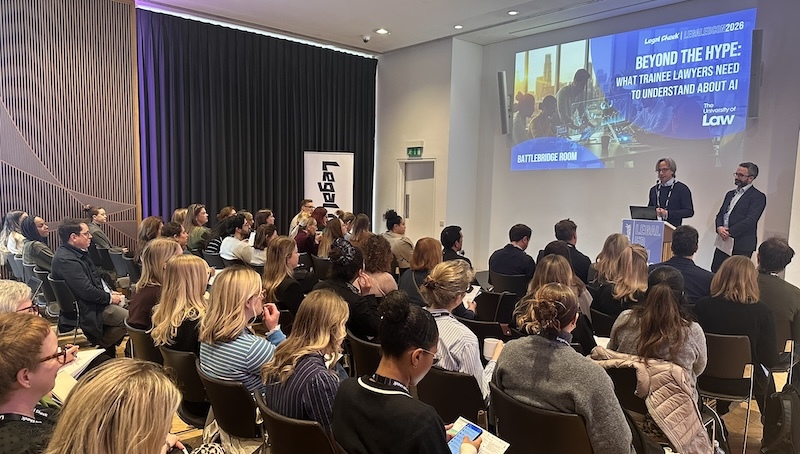
Beyond the hype: What trainee lawyers need to understand about AI
The speakers:
- Patrick Grant, Lecturer and Project Director for Legal Tech and Innovation at The University of Law, Leeds
- Adam Roney, CEO of Calls 9 and Kalisa and Visiting Lecturer at The University of Law
Delivered by Patrick Grant, Associate Professor of AI and Technology at ULaw, and Adam Roney, Founder and CEO of Calls 9 and Kalisa and Visiting Professor at ULaw, the session wasted no time cutting through the noise. The opening framing set the tone for everything that followed: generative AI does not search for answers, it predicts the next most likely word. It has no concept of truth, facts, or law, and it is extraordinarily good at sounding right even when it is completely wrong! That is not a bug. That is the architecture.
From there, the speakers walked through where AI is already embedded in legal workflows, covering document review, contract analysis, research and drafting, before turning to the failure modes every trainee needs to understand. Hallucination, recency blindness, jurisdiction confusion, and the confidentiality risks of feeding client data into public tools were all addressed in detail.
The session was equally direct about the gap between those who are AI-enabled and those who are AI-dependent, arguing that the skills defining the next generation of lawyers are prompt craft, output verification, workflow judgement, and the ethical awareness to know when not to use the tools at all.
For the firms in the room, the challenge was clear: do not wait for graduates to arrive pre-equipped. Induction, supervision culture, and policy clarity all have a role to play, and the liability question needs an answer before
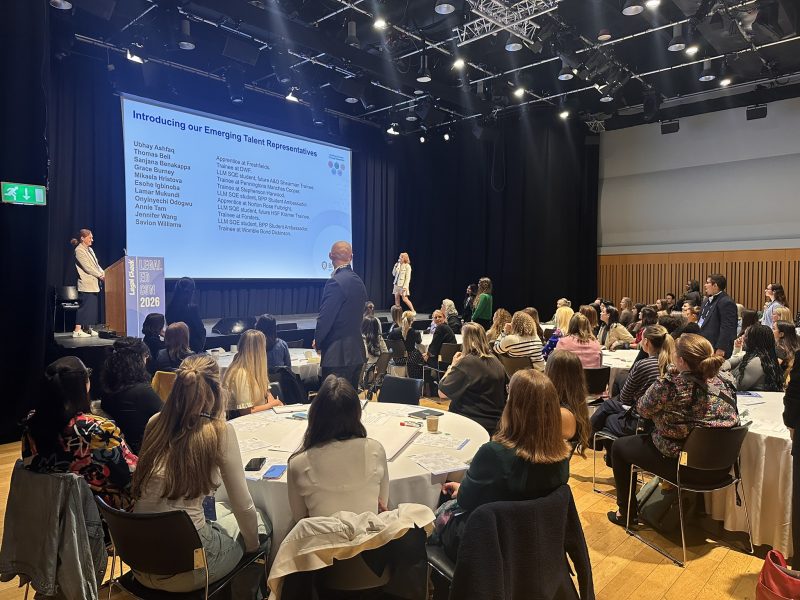
Understanding what motivates emerging talent in an ever-changing world
The speakers:
- Clare Wardell, Legal Apprenticeship Experience Project Lead at BPP University Law School
- Julie Manson, Module leader at BPP University Law School
Delegates sat in small groups, each accompanied by current trainees, future trainee solicitors and apprentices from firms including Freshfields, DWF, Norton Rose Fulbright, Stephenson Harwood and Womble Bond Dickinson.
The workshop, led by Clare Wardell, Deputy Director of Legal Apprenticeship Programmes at BPP, and Julie Manson, Module Leader for Professional Skills and Behaviours at BPP, set out to answer a question that more firms are taking seriously: what actually motivates the next generation of lawyers, and what happens when you get it wrong?
The answer, according to the 2025 Gen Z and Millennial Survey, is fairly consistent. Emerging talent wants career progression, learning and development, purpose-driven work and a decent work-life balance. They want managers who mentor rather than just delegate. They want their mental health taken seriously. And with the traditional university route becoming an increasingly expensive default, many are weighing up alternatives and looking for employers who understand that.
The session also introduced the concept of Perceived Organisational Support, which in practice comes down to a simple question: do your people feel valued and cared for? The research is clear that those who do are far more likely to stay because they want to, not because they feel they have to.
The emerging talent in the room shared what that looks like day to day, from regular feedback and accessible managers to being introduced in meetings and copied on emails.
Groups then put that to work in a structured discussion, each tasked with identifying one concrete action their organisation could take in the next six months to better engage and retain emerging talent.
Practice-ready or exam-ready? Using data to predict performance

The speakers:
- Andy Suszek, VP of Data Strategy and Analytics at BARBRI
- Camilla Brignall, Learning and Development Manager at Linklaters
- Eleanor Beattie, Senior Early Careers Manager at Baker McKenzie
- Professor Nigel Spencer, Director, Hub for Professional Practice at QMUL Law School
The session was chaired by Andy Suszek, VP of Data Strategy & Analytics at BARBRI, who opened by sharing findings from a large-scale study of 5,048 first-time SQE takers across four years. Drawing on 112 independent variables, from course length and student category to detailed performance metrics from multiple-choice questions and simulated examinations, the research set out to identify what, beyond raw exam results, is most predictive of a candidate passing.
The data formed the backbone of a wide-ranging panel discussion that also touched on what it means to be truly prepared for legal practice, not just for the exam. Joining Suszek were Eleanor Beattie, Senior Early Careers Manager at Baker McKenzie; Nigel Spencer, Director for Professional Practice at QMUL Law School; and Camilla Brignall, Learning and Development Manager at Linklaters, bringing together perspectives from a global law firm, a leading law school, and one of the Magic Circle.
A central theme was the gap between exam performance and workplace readiness, and whether the metrics used to track the former are sufficient to anticipate the latter. The panel examined how firms and providers might use richer data to identify candidates who need additional support earlier, and how course design can be better aligned with the realities of practice.
TC Recruitment in the AI age

The speakers:
- Tom Wickstead, Head of Talent at Mishcon de Reya
- Tara Davis, Early Careers Recruitment Lead at Macfarlanes
- Sophie Thomas, Talent Recruitment Manager at Linklaters
- Rebecca Schrod, Senior Early Careers Recruitment & Development Manager at Reed Smith
- Tom Brightwell, Chief Product and Technology Officer at Brightnetwork
The panel discussion brought together representatives from several leading law firms to explore how the profession is adapting its training contract recruitment processes in response to AI, in particular as it relates to the increase in volume of applications caused by the use of AI by candidates.
Tom Wicksteed and Tom Brightwell from Mishcon de Reya and Bright Apply opened the discussion by showcasing their collaborative AI-powered application process, which replaces traditional written application forms with a conversational, chat-based interview. They discussed the safeguards needed, including allowing candidates to review and correct AI-generated summaries, with all hiring decisions remaining in human hands.
Other firms shared contrasting approaches. Rebecca Schrod from Reed Smith described a deliberate restructuring of their process: candidates now complete an online legal aptitude test and video interview before being asked to answer written application questions, a reversal of the traditional sequence designed to ensure the more AI-susceptible written elements come later, once candidates have already demonstrated themselves in a less easily-gamed format.
Tara Davis from Macfarlanes walked through their two-stage online model: an initial sift using assessments is followed by a job simulation in which candidates join a fictional project team and work through situations closely mirroring those faced by trainees. Most stages are assessed application-blind, with contextual recruitment tools used to interpret candidates’ achievements relative to their background.
Sophie Thomas discussed Linklaters’ process which centres on a short online form, a Cappfinity behavioural assessment, and the Watson Glaser critical thinking test. The firm’s representative discussed one safeguard against AI-assisted cheating: re-administering the Watson Glaser at the in-person assessment day, allowing recruiters to cross-reference candidates’ in-person performance against their online results and flag significant discrepancies.
Running through the discussion was a tension familiar to early careers teams: how to process ever-growing application volumes without sacrificing fairness or depth of assessment. Panellists discussed the risk of bias in AI-assisted screening, the difficulty of ensuring assessments remain AI-proof and the persistent challenge of giving meaningful feedback to unsuccessful candidates.
QWE, new routes and paralegals

The speakers:
- Nikki Lewis, Managing Associate at Linklaters, qualifying through the CILEX route
- Reccy Midigo, Legal Counsel at the University of Birmingham
- Luke Nelson, Trainee Solicitor at at Accutrainee, seconded to Pizza Express
After each panellist gave a short overview of their career journey, the discussion turned to the decision itself. For some, choosing a different route was a deliberate and positive choice; for others, it developed gradually. The panel reflected on the role of family, colleagues and mentors in shaping their paths, and the degree to which they had faced scepticism along the way.
The conversation then examined what each route actually involved in practice. Nikki walked through the structure of the CILEx pathway. Reccy described the reality of managing QWE as a paralegal, including how much of the process she had to figure out for herself. Audience participation at this point flagged a wider uncertainty around what actually constitutes QWE, confusion that, it was noted, stems in part from the SRA’s broad definitions.
A frank discussion followed about supervisors refusing or failing to sign off QWE, with the question raised of whether this reflects a lack of awareness, structural reluctance to promote paralegals, or both, and whether the SRA should be doing more to support the route.
On perception, the panel addressed head-on the view that anything other than a training contract is a lesser route into the profession, and offered an honest assessment of how much the profession’s stated commitment to widening access is translating into practice.
The session closed with the panel sharing what they wish they had known earlier, and what those in the room with responsibility for recruitment could do differently to better support people taking alternative paths into the law.
Lunch and networking

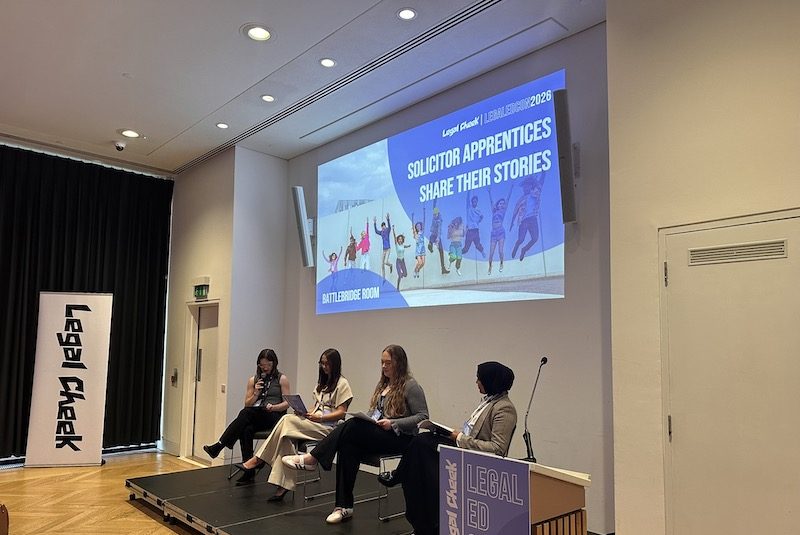
Solicitor apprentices share their stories
The speakers:
- Nawal Bin-Sheikh, Fourth Year Solicitor Apprentice at Simmons & Simmons
- Charlie Moore, Solicitor Apprentice at DWF
- Lucy Jackaman, Solicitor Apprentice at Gowling WLG
Three solicitor apprentices, Nawal Bin-Sheikh at Simmons & Simmons, Charlie Moore at DWF, and Lucy Jackaman at Gowling WLG, each gave a short talk on their journey before opening up to a panel discussion.
The conversation began with the decision to pursue the apprenticeship route rather than the traditional university pathway. The panel reflected on whether they had encountered scepticism along the way and how much those around them, family, colleagues and mentors, had shaped their choices. There was an honest exchange about what they may have missed by not going to university, set against the experiences and early professional exposure they had gained in its place.
Discussion turned to the day-to-day reality of balancing fee-earning work with formal legal study, a challenge all three acknowledged, along with the strategies and support systems that had helped them manage it. Jackaman spoke to her experience of SQE preparation specifically, and what her firm and training provider had offered. The panel also explored why solicitor apprentices consistently outperform other cohorts on SQE pass rates, with the view emerging that learning law in a live professional environment builds a kind of applied understanding that classroom study alone struggles to replicate.
Each panellist also reflected on their individual journeys. Bin-Sheikh discussed how rotating across practice areas, including a seat in the Business Services team, had shaped her understanding of commercial law. Jackaman spoke about a secondment with the Government Legal Department’s Defence, Security and Public Law team and how working in government differed from private practice. Moore, who came to the apprenticeship via the CILEx route and a senior paralegal role, reflected on how that prior experience had influenced his progression.
The session closed with the panel sharing what they wished they had known before starting, and whether the solicitor apprenticeship route has genuinely delivered on the profession’s promise of widening access.
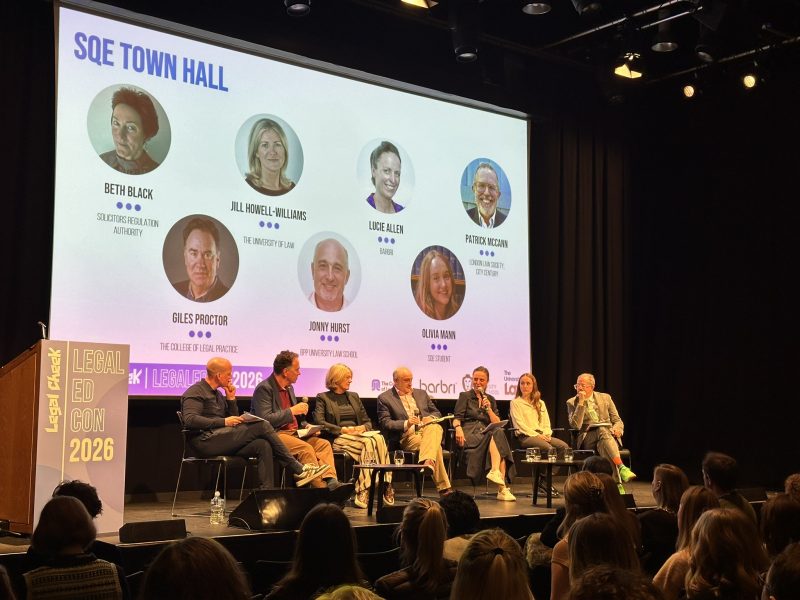
SQE Town Hall
The speakers:
- Beth Black, Director of Education and Training at the Solicitors Regulation Authority
- Patrick Mcann, Chief Executive of City of London Law Society and Co-CEO of City Century
- Dr Giles Proctor, Chief Executive Officer of The College of Legal Practice
- Lucie Allen, Co-CEO at BARBRI
- Jonny Hurst, SQE TV Founder and Director of Outreach at BPP University Law School
- Jill Howell-Williams, Programme Director of SQE at The University of Law
- Olivia Mann, SQE Student/Paralegal
A panel of leading voices from across the legal education sector came together for a Town Hall discussion on the SQE, exploring everything from pass rates and student confidence to transparency, cost, and the long-term promise of the qualification. The SRA’s new Director of Education and Training opened the session with a short address before handing over to the panel.
A panel from the City of London Law Society and major SQE prep providers tackled several pressing issues. The record-low SQE1 pass rate of 41% sparked debate over whether the exam’s difficulty filters out unsuitable candidates or unfairly sidelines those who would have made strong solicitors, with real consequences including rescinded training contracts.
Providers called for better data sharing, particularly the long-overdue provider-level pass rate statistics. On affordability, with fees now topping £5,000 and 82% of aspiring solicitors questioning the SQE’s value in a recent survey, the panel acknowledged questions remain about whether the exam’s original promise of widening access to the profession has been fulfilled. The session ended on a brighter note, with an independent review rating 2025 SQE delivery as “good” and solicitor apprentices continuing to outperform other cohorts.
How law degrees are changing
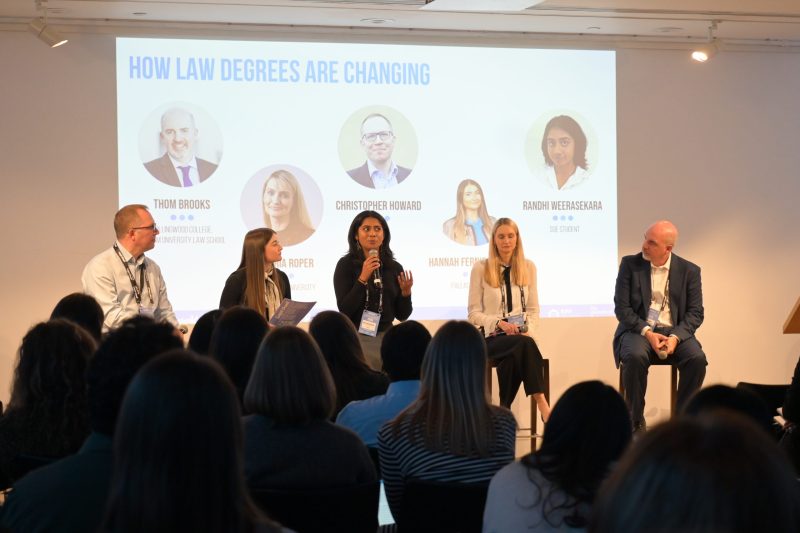
The speakers:
- Hannah Fenie-Clarke, Legal Assistant at Pallas Partners LLP
- Randhi Weerasekara, Current SQE student and Previous PGDL student at King’s College London
- Victoria Roper, Associate Professor at Northumbria University
- Christopher Howard, University Partnership Director at BARBRI
The session brought together speakers from a range of universities to explore how legal education is adapting in the wake of the SQE and whether the LLB remains fit for purpose in its current form.
A central debate was whether SQE content is best incorporated at postgraduate level, or whether it belongs in the undergraduate degree at all. Some speakers argued that universities should focus on academic rigour and research, leaving professional preparation to specialist providers. Others questioned what the LLB is actually preparing students for, if its content doesn’t align neatly with either the SQE or the practical demands of a training contract.
Speakers also pushed back on the assumption that embedding SQE preparation into degrees is straightforwardly beneficial. Senior figures in legal education suggested that institutions should continue doing what they do well, rather than reshaping curricula around a qualification that may itself need updating, particularly to reflect emerging skills around technology and AI.
The discussion also touched on Qualifying Work Experience. While law schools can offer experiences that count towards QWE, the consensus was that this would only account for a small portion of what candidates need, and that students must think strategically about how to build a broader portfolio of experience that strengthens their training contract applications.
One highlight was the model at KCL, where seminar groups are structured around law firm simulations, with client-focused, problem-based learning — an approach that develops SQE2-relevant skills organically within the degree.
Companion apps
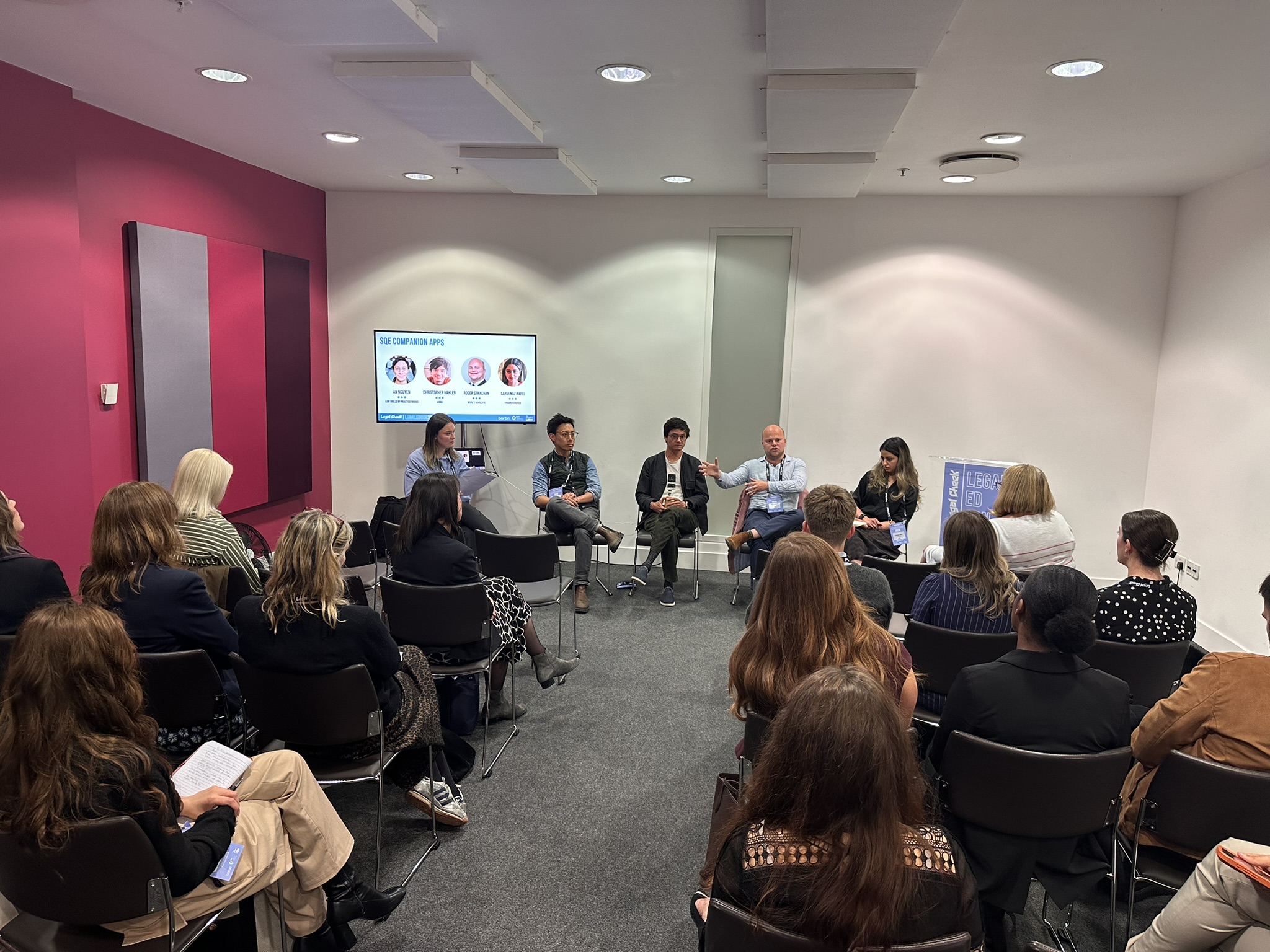
The speakers:
- An Nguyen, Founder of Law Drills by Pratice Works
- Roger Strachan, Director of Devil’s Advocate
- Christopher Kahler, Co-Founder of Kinnu
- Sarvenaz Naeli, Co-Founder of THEONEHUNDRED
This panel brought together founders and directors from some of the leading SQE companion app platforms to explore how technology is reshaping the way students prepare for the Solicitors Qualifying Examination (SQE).
The session moved beyond the core SQE providers to examine the growing ecosystem of supplementary study tools and, crucially, why students are turning to them. Central to the discussion was the question of Gen Z learning habits: a generation that expects learning to be bite-sized, on-demand, interactive, and woven into their daily routines rather than confined to a desk.
Panellists discussed how companion apps are responding to this shift by offering features such as spaced repetition, gamified practice questions, and mobile-first design, meeting students where they already are, on their phones, in short windows of time throughout the day.
The conversation also touched on how these tools complement, rather than replace, traditional SQE prep, helping students reinforce knowledge between study sessions, track their progress, and build confidence ahead of assessments.
Junior lawyer burnout: what’s behind it, and how can you avoid it

The speakers:
- Emma Jones, LawCare Trustee
- Inês Pinheiro, Founder of Deary Me Today
- Chris Ballantyne, High Performance Coach | Former Lawyer, Weil Gotshal & Deutsche Bank VP
- Kanika Kitchlu-Connolly, Coach and Mentor at Kitchlu Coaching
The panel brought together four speakers with first-hand experience of burnout in legal careers: a researcher, a former lawyer turned career coach, a high-performance coach with a decade in financial law, and a junior lawyer who left the profession entirely. Together, they explored both the roots of the problem and what can realistically be done about it.
Emma Jones, Trustee at LawCare, opened by defining burnout and presenting findings from the Life in the Law report, which identifies the cultural and structural conditions that drive it: poor work allocation, a lack of meaningful recognition, and the frequent promotion of technically brilliant lawyers into management roles they have no training for. She also sounded a warning about the cost of inaction (lawyers are leaving the profession in growing numbers due to poor mental health) and argued that policy and structural reform matter just as much as individual resilience.
Chris Ballantyne drew on his own experience in the high-octane world of legal practice to explore how lawyers tend to overextend themselves. He examined the particular pressures that come with feeling compelled to perform constantly, and what individuals can practically do to resist that pull. Drawing on his coaching experience, he discussed the steps individuals can take to avoid burnout, such as taking care of their physical, as well as the costs of burn out to both law firms and lawyers.
Kanika Kitchlu-Connolly brought her perspective as both a coach and a former law firm partner to argue that meaningful change must come from the top. She focused on the tension firms face in rewarding their highest billers, who may model harmful behaviours, even when doing so damages the wider culture — and made the case for rethinking how partners are incentivised, not just how junior lawyers are supported.
Inês Pinheiro spoke from her own experience of leaving her training contract at DLA Piper, making the case for normalising these conversations within firms themselves. She noted that junior lawyers often stay silent for fear of jeopardising their positions, and, building on Ballantyne’s points about performance, reflected on the particular exhaustion of having to suppress one’s identity to get ahead in a corporate environment.
The next horizon of diversity and inclusion

The speakers:
- Kyle Blackburn, Chair of Black Solicitors Network
- Morag Duffin, Director of Student Success at The University of Law
- Rebecca Carter, London Managing Partner at Stephenson Harwood
- George McNeily, Early Talent Partner at DWF
This panel brought together law firms, academia and professional networks to examine how the legal sector can sustain meaningful progress on diversity and inclusion at a moment when several converging forces are pushing back against it.
Panellists were frank about the headwinds. The rise of extreme politics has created a cultural climate in which D&I commitments are increasingly contested, while concerns have been raised that the SQE, in practice, may be disproportionately favouring white, male and middle-class candidates. Adding further complexity, the growing use of AI in job applications has prompted some firms to lean back on traditional academic proxies like A-Level results, a move that risks entrenching the very barriers the profession has spent years trying to dismantle.
The discussion made clear that progress on diversity cannot be treated as a fair-weather commitment. It requires active, intentional effort from firms, educators and professional bodies working in concert, particularly when the conditions are most challenging.
Media training workshop: how to deal with journalists and maximise PR opportunities
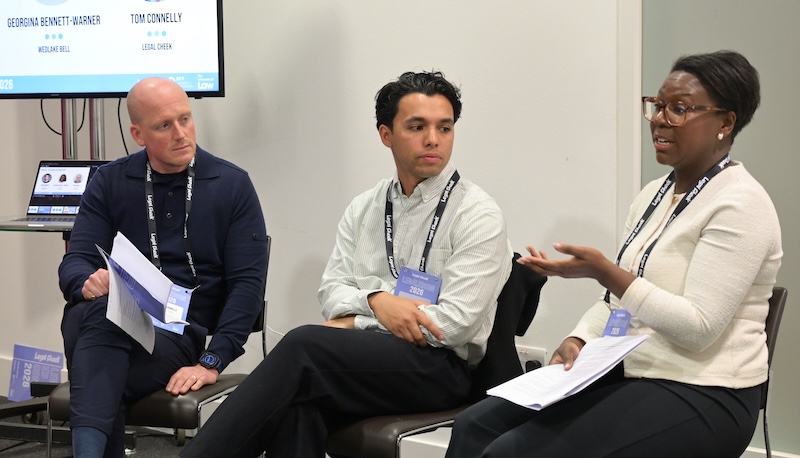
The speakers:
- Adam Mawardi, Professional Services Editor at Financial News
- Georgina Bennet-Warner, Head of Marketing at Wedlake Bell
- Tom Connelly, Director at Legal Cheek
The session opened with a quick poll asking delegates to rate their confidence engaging directly with a journalist, before the workshop featuring Adam Mawardi, Tom Connelly, and Georgie Bennett-Warner got underway.
The early discussion focused on what makes a graduate recruitment story genuinely newsworthy. TC numbers, salary changes, retention rates, and innovations in work experience all made the list, but the panel was equally candid about what doesn’t work.
Pitches that are heavily marketing-led, lack a concrete hook, or arrive weeks after a competitor has covered similar ground rarely land. Mawardi walked through how exclusives in the graduate recruitment space tend to come about and what separates a well-placed story from a missed opportunity.
A recurring theme was the disconnect between PR functions and graduate recruitment teams, with firms’ communications resource naturally gravitating toward partner moves and major deals. The panel discussed how simple internal processes can be the difference between a strong exclusive and a story that never gets told, and whether grad rec teams should cultivate direct relationships with journalists rather than routing everything through a central PR function.
The session also tackled a more sensitive dynamic: firms that actively block potentially positive stories, including salary rises and TC increases, despite these being among the most-read stories in the student market. The conversation then turned to the growing influence of lawfluencers and what that shift means for firms’ ability to control their own narrative.
Keynote
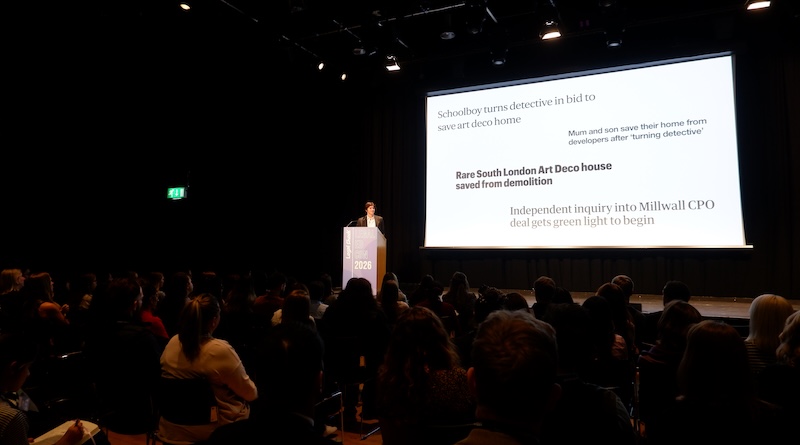
The speaker:
- Alexander Kardos-Nyheim, Founder & CEO, Safe Sign Technologies (acquired by Thomson Reuters)
Alexander Kardos-Nyheim delivered one of LegalEdCon 2026’s most talked-about keynotes, charting his journey from trainee solicitor to AI researcher at one of the world’s largest legal information companies.
Kardos-Nyheim told the audience how he founded Safe Sign Technologies while completing his training contract at A&O Shearman, driven by a belief that existing AI models were not built for the precision and reliability that legal work demands.
The road was far from straightforward, he explained. The business came close to collapse on multiple occasions, an initial consumer-facing launch failed, and progress had to be made alongside the gruelling demands of a Magic Circle training contract. Eventually, the startup’s research gained recognition at leading AI conferences, attracting the attention of Thomson Reuters, which acquired the company in 2024. Kardos-Nyheim now co-leads AI research there globally.
Turning to AI’s broader impact on the profession, he told delegates that firms would diverge, with some treating the technology primarily as a cost-cutting tool and others using it to move junior lawyers towards more substantive work earlier in their careers. He also cautioned the audience that certain skills risked being lost as repetitive tasks disappeared.
Legal Cheek’s managing director Alex Aldridge brought the conference to a close by thanking the speakers, delegates and headline sponsors BARBRI, BPP University Law School and The University of Law, as well as silver sponsor The College of Legal Practice and additional sponsors Oxford University Press, Kinnu and THEONEHUNDRED.